
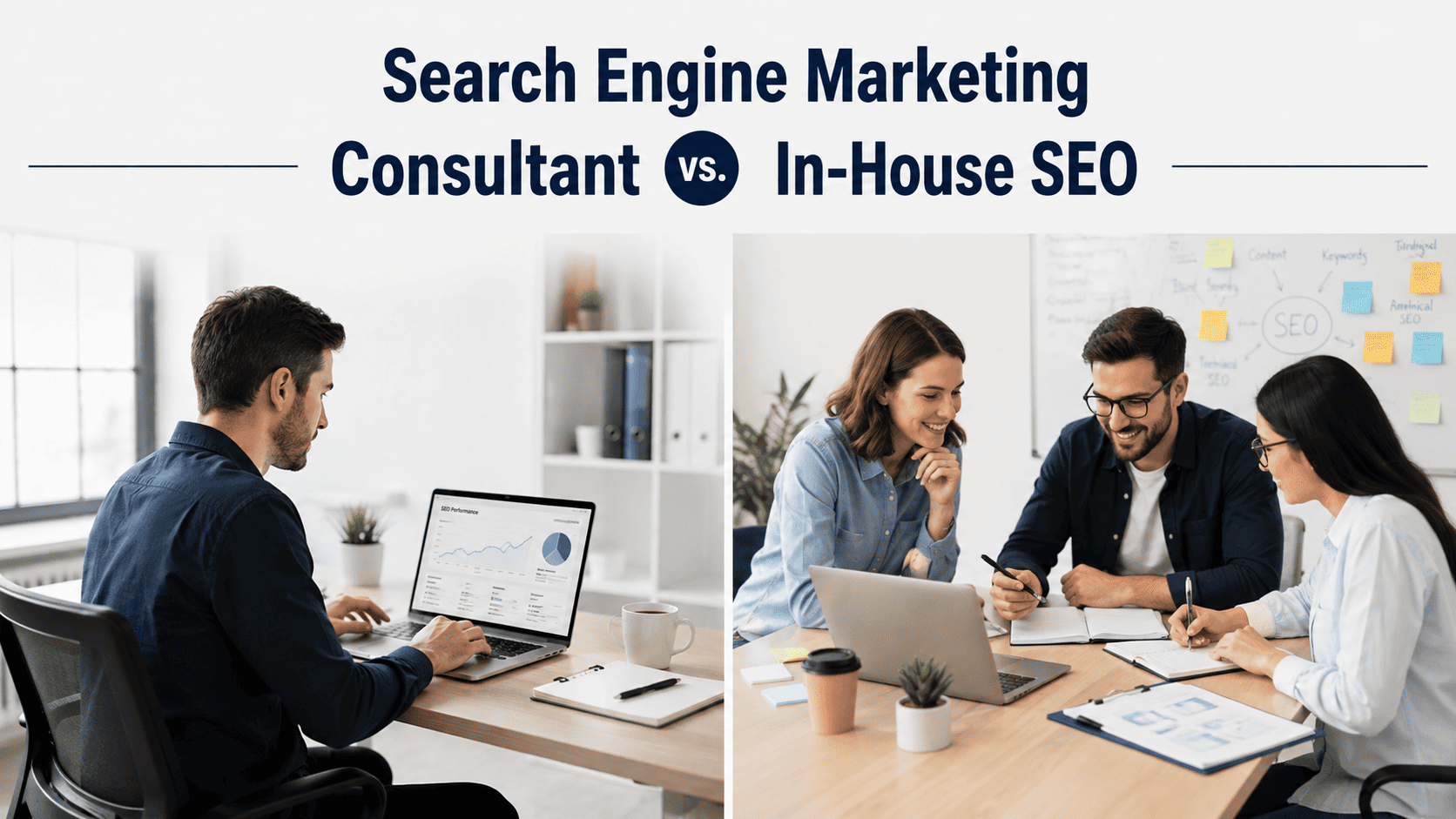
Search Engine Marketing Consultant vs. In-House SEO: Which One Fits Your Business?
Deciding whether to hire a search engine marketing consultant or build SEO in-house comes down to three things: your budget, your team’s bandwidth, and how fast you need results. This post breaks that choice into a plain framework, so you pick the option that fits your business instead of the one a job board or a sales pitch is pushing on you.
Quick Summary
A search engine marketing consultant can help plan and manage your search strategy, while an agency provides a full team of specialists. Choose in-house SEO for steady, high-volume work, or an agency for specialist expertise and faster results. For many small and mid-sized businesses, a hybrid approach with one internal owner and an agency can work well. The right choice depends on your workload, budget, goals, and competition.
What a Search Engine Marketing Consultant Actually Does
An SEO marketing consultant improves how your website shows up in search results. That’s the short version. The real work is a repeatable process, not a one-time tweak.
Most structured engagements follow the same five stages:
- Audit. Check the site’s current technical health, content coverage, and existing visibility. This is the baseline everything else is measured against.
- Research. Identify the keywords, competitors, and search intent that show where the real opportunity sits.
- Strategy. Build a prioritized roadmap based on impact, not guesswork.
- Optimize. Improve content, page structure, technical elements, and internal links according to that roadmap.
- Measure.Track performance and adjust as search behavior and results shift over time.
A consultant handles the thinking and the direction. Whether they also handle the hands-on execution depends on the engagement and the size of your team.
What Hiring In-House Actually Involves
Bringing SEO in-house means hiring a full-time person and owning everything that comes with them. People underestimate the total commitment because they only think about the salary.
Here’s what the real cost looks like:
- Salary. In the US, SEO specialist salaries commonly fall between roughly $55,000 and $95,000 a year depending on experience and location, based on 2026 figures from salary trackers like Glassdoor and Salary.com. Senior specialists and managers sit at the higher end.
- Tools. Professional platforms like Ahrefs or Semrush carry monthly subscription costs on top of the salary. One person still needs the same software a team would use.
- Ramp-up time. A new hire needs time to understand your site, your market, and your history before they produce results. That gap is a real cost, even if it never shows up on a budget line.
In-house works well when you have consistent, high-volume SEO work, the budget to support it, and enough related roles (content, development, design) for that person to coordinate with. For a business with occasional or seasonal SEO needs, a full-time salary is hard to justify.
What You Get from an SEO Marketing Services Agency
Working with an SEO marketing services agency gives you a team instead of a single hire. That’s the core difference, and it matters more than it sounds.
SEO isn’t one skill. It’s several: technical SEO, content, on-page optimization, and strategy. One in-house generalist can cover the basics of each, but rarely at expert depth across all of them. An agency puts a specialist on each part.
What a full-service agency typically brings:
- A technical specialist who handles crawling, indexing, and site performance issues.
- A content and on-page team that aligns pages with how people actually search.
- Strategy oversight that ties the pieces together into one roadmap.
- Tools and processes are already in place, so there’s no setup lag or subscription to expense on your side.
If you want to see how a structured engagement is built end to end, our SEO Marketing Services page walks through the full process, from the first audit to ongoing measurement.
The trade-off: an agency team splits attention across clients, while an in-house hire works only on you. Which matters more depends on how much hands-on availability you need day to day.
In-House vs. Agency: A Side-by-Side Look
Most search engine marketing agencies and in-house hires trade the same set of strengths back and forth. Here’s how they stack up on the factors that actually drive the decision.
| Factor | In-House | Agency |
| Cost | Salary + tools + training, paid whether the workload is full or light | Fixed engagement cost; no salary, tools, or hiring overhead |
| Speed to results | Slower at first; a new hire needs ramp-up time | Faster; the team and systems already exist |
| Expertise breadth | One generalist covering several areas | Multiple specialists, each focused on their part |
| Scalability | Limited by one person’s hours | Scales up or down with your needs |
| Control & availability | High; the person works only on your business | Shared attention across clients |
Neither column wins outright. In-house gives you control and focus. An agency gives you breadth and speed. Your answer depends on which of those your business needs most right now.
When You Need a Web SEO Company vs. When You Don’t
Not every business needs to outsource. Before you hire a web SEO company, it’s worth being honest about whether you actually need one.
You probably don’t need to outsource yet if:
- You run a small local business with simple, low-competition search goals.
- You have the time to handle the basics yourself.
- Your SEO needs are occasional rather than ongoing.
Google itself makes this point. In its official guidance on hiring an SEO, Google notes that a small local business can often do much of the work in-house and recommends starting with the fundamentals before paying anyone. You can read that guidance directly in Google’s Do You Need an SEO? documentation.
You likely do need outside help when:
- You’re redesigning or launching a site and want it built search-friendly from the start.
- Your competition is heavy, and casual effort isn’t moving rankings.
- You don’t have the time or the internal skills to keep up with the work.
- SEO is a core growth channel, not a side project.
The clearer you are about which situation you’re in, the less likely you are to overspend on help you don’t need or underinvest when you actually do.
How to Choose an SEO Content Marketing Agency
Once you’ve decided to outsource, choosing the right SEO content marketing agency is where most of the risk lives. A bad fit wastes months. A good one compounds.
Run through this checklist before you sign anything:
- Ask for real results and references. Request examples of past work and talk to former clients about whether the agency was easy to work with and delivered.
- Check how they communicate. They should be willing to explain every change they make and the reasoning behind it. Secrecy is a red flag.
- Watch out for guarantees. No one can promise a #1 ranking on Google. Anyone who does is either misinformed or misleading you.
- Judge their own content. An agency that sells content marketing should demonstrate quality and credibility in its own work. Google’s quality standards lean on E-E-A-T experience, expertise, authoritativeness, and trustworthiness, and an agency worth hiring should show those signals in the content it publishes.
- Confirm the process is transparent. You should always understand what’s being done and why. If the plan is a black box, keep looking.
Key Takeaways
- A search engine marketing consultant plans, audits, and optimizes your search visibility. An agency gives you a full team behind that same work.
- In-house makes sense when you have steady, high-volume SEO work and the budget to pay a salary plus tools.
- An agency makes sense when you want a range of specialists without hiring several people, or you need results faster than a single new hire can deliver.
- A hybrid setup (one internal owner plus an agency) is common and often the most practical for small and mid-sized businesses.
- There’s no universal “right” answer. The correct choice depends on your goals, your competition, and how much SEO work you actually have month to month.
Conclusion
The choice between a search engine marketing consultant, an in-house hire, and a full agency isn’t about which one is “better.” It’s about matching the option to your workload, budget, and how fast you need to move. In-house gives you control and focus but costs a full salary plus tools and ramp-up time. An agency gives you a bench of specialists and faster results, with attention split across clients. For many small and mid-sized businesses, a hybrid of the two ends up being the most practical answer.
If SEO is a real growth channel for your business, the next step is a straight conversation about where your site stands today and what’s actually worth doing. That’s the fastest way to stop guessing and start working from a plan built for your specific situation.
If that’s worth a conversation, our SEO marketing services lay out exactly how the work runs. When you’re ready, talk to our team about where your site stands right now, and we’ll tell you straight whether you need us, need a smaller fix, or can handle it yourself.
FAQs
Is a search engine marketing consultant the same as an SEO agency?
No. A consultant is usually one person who plans, audits, and advises on your search strategy. An agency is a team that covers the same work with specialists in technical SEO, content, and strategy. A consultant fits smaller or more focused needs; an agency fits broader or higher-volume work.
How long does SEO take to show results?
There’s no fixed timeline, and anyone who promises one is guessing. Results depend on your starting point, competition, and how much work the site needs. SEO is an ongoing effort rather than a one-time fix, because search behavior and competition keep shifting. Treat it as a process you revisit, not a switch you flip.
Can a small business handle SEO without hiring anyone?
Often, yes. Google recommends that small local businesses start with the fundamentals themselves before paying for outside help. If your goals are simple and your competition is light, you can cover a lot of ground on your own. You’d move toward hiring when the work outgrows your time or skills.
What should I ask before hiring an SEO content marketing agency?
Ask for examples of past work and client references, how they measure success and in what timeframe, how they’ll communicate changes, and whether they follow Google’s guidelines. Be skeptical of anyone guaranteeing rankings or refusing to explain what they’ll actually do.