Building an ORM Strategy With the Right Reputation Management Tools
A regional retail chain assigned one employee to “handle” their online reviews. She checked Google once a week, replied when she remembered, and had no idea the business also had a Yelp profile with eleven unanswered complaints. Nobody had ever told her to look.
That gap between having a policy and having a system is where most reputation management strategy falls apart. Tools exist to close it, but only when they’re set up as part of an actual workflow, not bolted on after a crisis already started. A strategy without tools is guesswork. Tools without a strategy just generate alerts nobody reads.
This guide walks through the reputation management tools worth using and the step-by-step ORM strategy that turns those tools into consistent results.
TL;DR: An effective ORM strategy combines monitoring tools (Google Alerts, Mention, Semrush Brand Monitoring), a defined review response workflow, and a regular schedule for checking search result reputation. The goal is catching mentions and reviews fast enough to respond before they shape a stranger’s first impression. See what online reputation management is and why it matters for the foundational concepts this strategy builds on.
What an ORM Strategy Actually Requires
An ORM strategy requires three connected pieces working on a schedule: monitoring tools that catch mentions and reviews, a response workflow that handles them consistently, and periodic search result checks that confirm the overall picture is improving. Skipping any one piece leaves a gap the other two can’t cover.
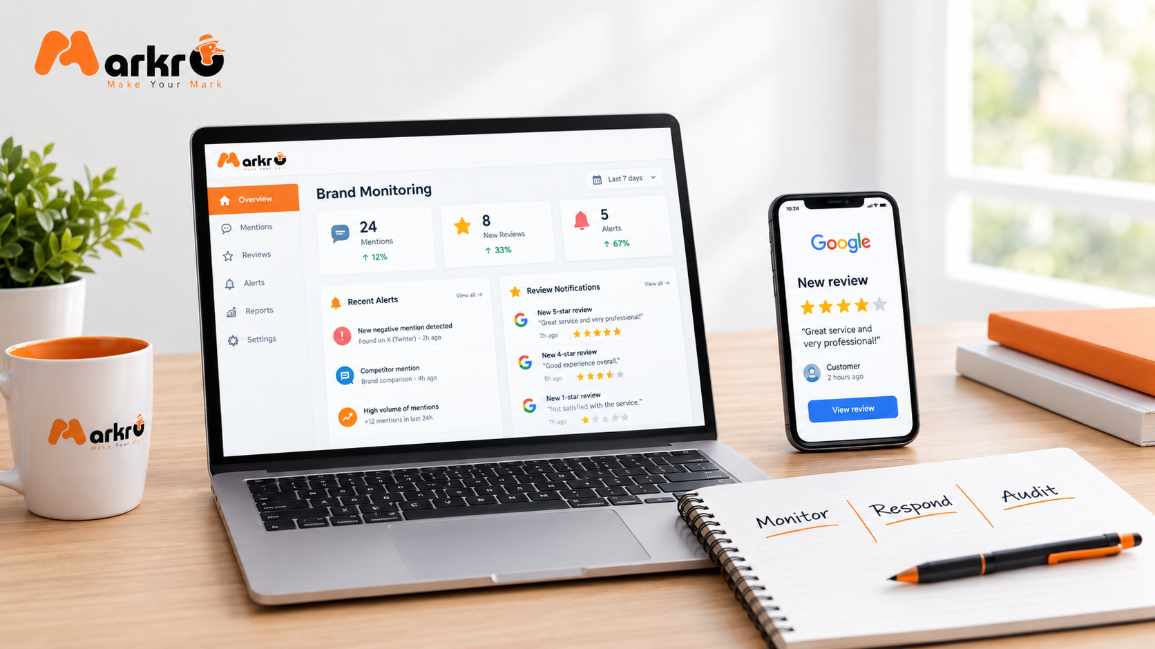
Most businesses start with monitoring and stop there. Reputation management tools flag six new reviews on Tuesday morning, then sit unread until Friday, if anyone reads them at all. The tools only pay off when someone owns responding to what they surface.
Reputation Management Tools Worth Setting Up
The right reputation management tools depend on business size, but a few core categories cover most needs.
| Tool Category | What It Tracks | Example |
| Mention tracking | Brand name across the web | Google Alerts, Mention |
| Review monitoring | New reviews across platforms | Google Business Profile, Semrush |
| Social listening | Comments and tags on social media | Native platform notifications |
Google Alerts and Mention Tracking
Google Alerts sends a notification whenever a business’s name appears in new content indexed by Google. Mention, a paid alternative, adds social media coverage and broader web tracking that Google Alerts misses, catching forum posts and smaller sites that Google indexes more slowly.
Semrush Brand Monitoring
Semrush Brand Monitoring tracks branded search volume alongside mentions, giving a clearer picture of how search result reputation shifts over time, not just whether new content appeared. This is useful for spotting whether a negative story is actually gaining traction or sitting unnoticed.
Pro tip: Set monitoring alerts to a shared inbox or channel, not one person’s personal email. A single point of failure means reviews go unanswered the moment that person is out sick or on vacation.
Online Review Monitoring Across Platforms
Online review monitoring has to cover every platform a business is actually listed on, not just Google. A business can maintain a spotless Google rating while a Yelp or Trustpilot profile accumulates unanswered complaints in the background, invisible to anyone only checking the one platform they think matters most.
Platforms Worth Checking Regularly
- Google Business Profile, the platform most customers check first
- Yelp, especially for restaurants, retail, and local service businesses
- Trustpilot, common for e-commerce and service-based companies
- Facebook, where reviews sit alongside comments and direct messages
Checking every platform weekly, on a fixed day rather than whenever someone remembers, is what turns monitoring from an occasional task into an actual system.
Customer Review Management: Building a Response Workflow
Customer review management works best as a defined workflow rather than an ad hoc task handled whenever someone has time. Moz’s guide to reputation management points out that response speed matters as much as response quality, since a review sitting unanswered for weeks signals neglect to anyone reading it later.
A Practical Response Workflow
- Flag new reviews daily, even if the actual response happens later that week.
- Respond to negative reviews within 24 to 48 hours.
- Thank positive reviewers briefly; a generic response still shows the business is paying attention.
- Escalate serious complaints to a manager before posting a public response.
- Track resolution outcomes so repeat issues get flagged internally.
A workflow like this turns review management from a source of dread into a routine task with a clear owner and a clear process.
Search Result Reputation: What to Check and How Often
Search result reputation should be checked monthly at minimum, using an incognito or logged-out browser to see what an actual stranger would find. Search Engine Journal’s coverage of online reputation management recommends checking both the standard search results and the “News” tab, since older negative stories can resurface without warning when a related topic trends again.
What a Search Result Audit Should Cover
- The first page of results for the exact business name
- Image results, which can surface outdated or unrelated content
- The News tab, checked specifically for older stories that could resurface
- Autocomplete suggestions, which can reveal what people commonly search alongside the brand
Turning Monitoring Into an Ongoing ORM Strategy
Online reputation management services combine these individual tools and workflows into one ongoing system, rather than leaving a business to piece them together department by department. The businesses that get the most out of an ORM strategy treat it the same way they treat accounting: a recurring task with an owner, not a project with an end date.
An ORM strategy built on the tools above only holds up if someone actually checks the dashboard and acts on what it shows. Setting up Google Alerts and forgetting about it isn’t a strategy. Neither is a review response workflow nobody follows once the first busy week hits.
Markro Digital manages this as part of full digital marketing services, monitoring, response, and search result audits handled on a fixed schedule instead of reactively. For the tactical side, review response scripts and repair steps, see Markro Digital’s practical guide to online business reputation management. Get a free call to talk through a setup, or see the portfolio for documented results.
Author: Mudassir Ali writes on reputation monitoring systems and review response strategy for Markro Digital, helping businesses turn scattered alerts into an actual workflow.
Frequently Asked Questions: ORM Strategy and Tools
How do I monitor my online reputation?
Use tools like Google Alerts, Mention, or Semrush to track brand mentions. Regularly check review platforms like Google, Yelp, and Trustpilot for new feedback.
What is the difference between ORM and SEO?
SEO improves rankings for target keywords. ORM controls what appears when someone searches your brand name, suppressing negative results and promoting positive ones.
Should I hire a professional ORM service or manage it myself?
Basic monitoring and review responses can be handled in-house. For serious reputation damage, negative press coverage, or suppressing harmful search results, a professional ORM service is recommended.
What tools are best for tracking online reviews?
Google Alerts and Mention cover general brand mentions, while Semrush Brand Monitoring adds branded search tracking. For review-specific monitoring, checking each platform’s own dashboard, Google, Yelp, and Trustpilot, directly is still the most reliable method.
How often should a business check its online reputation?
Review monitoring should happen weekly at minimum, with a full search result audit monthly. Businesses in high-review-volume industries often check daily.