Advertising Services 101: What Every Business Owner Should Know Before Spending
Paid media splits into three channels that behave differently. This Advertising Services 101 breakdown compares search ads, paid social, and display so you can tell which one fits the problem you’re trying to solve.
Most businesses pick a channel based on what they’ve heard rather than what they need. Someone recommends Google Ads, so they run search campaigns for a product nobody searches for yet. Or they pour a budget into Facebook and Instagram expecting the same conversion rates a high-intent search click delivers. The channels aren’t interchangeable, and treating them that way is how ad budgets disappear without a trace.
What follows covers how each channel works, what it costs, when it makes sense, and the one place most advertisers get display wrong.
Quick Answer:
Search ads capture people already looking for what you sell. Paid social builds demand before that intent exists. Display keeps you visible while people browse elsewhere. This Advertising Services 101 comparison covers cost models, intent levels, and the right starting point for each, plus a look at why display gets written off too early.
Paid Advertising Services Cover Three Distinct Channels
Any conversation about paid advertising services eventually lands on the same three options. They share a billing model and almost nothing else.
The three channels at a glance
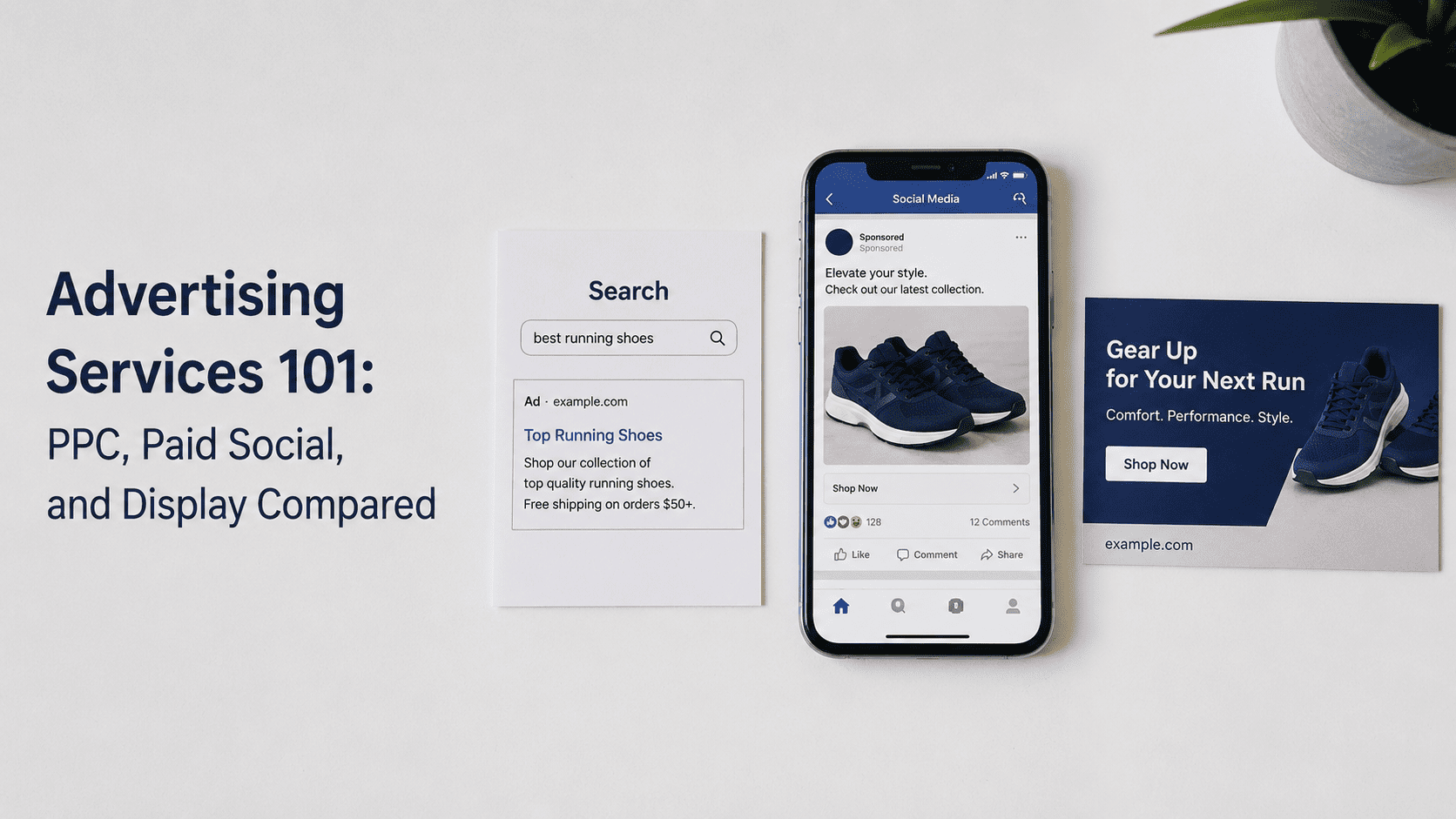
- Search ads (PPC). Text ads that appear above organic results when someone searches a term you bid on. You pay per click.
- Paid social. Ads placed inside social feeds on platforms like Facebook, Instagram, and LinkedIn. Targeting runs on interests, behaviors, and demographics rather than search terms.
- Display. Visual banner ads shown across websites and apps while people read, watch, or browse something else.
The difference that matters most is intent. Search reaches people who have already told a search engine what they want. Paid social and display reach people who haven’t asked for anything yet.
That single distinction explains most of what follows: why search costs more per click, why social wins on reach, and why display gets judged by the wrong metric.
Advertising Services 101: The Three Channels Side by Side
Here’s how the three digital advertising services stack up on the factors that decide where a budget should go.
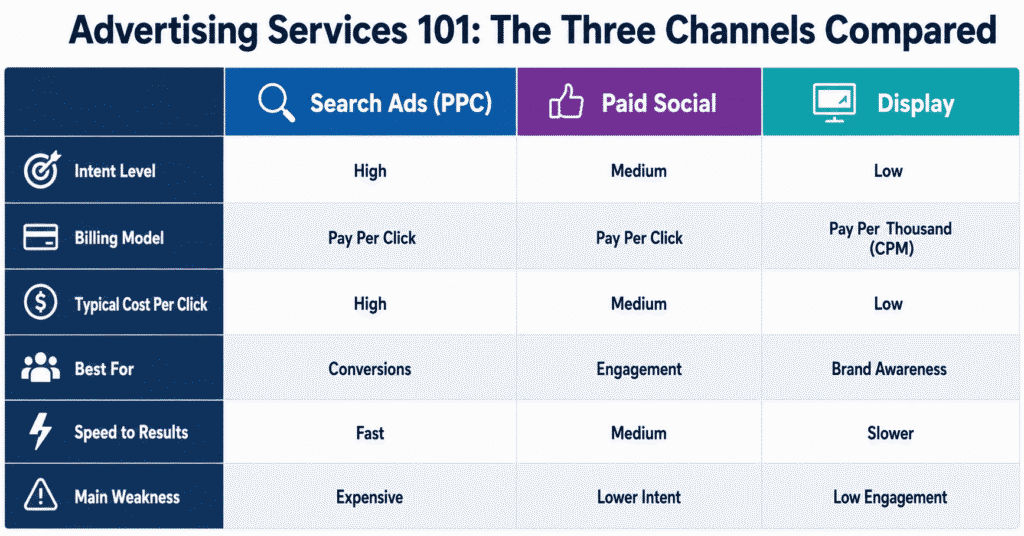
None of these columns is the winner. A local service business with steady search demand belongs in search. A new product nobody knows about yet belongs in social. A brand with an existing audience to stay in front of belongs in display.
Where the ads point matters as much as where they run. If your content management system makes landing pages slow to build or edit, every channel underperforms regardless of budget.
Online Advertising Services Start With Search Intent
Search is where most online advertising services begin, because the intent is already there. Someone typing “emergency plumber near me” has a problem right now. You just have to show up.
How search ads actually get priced
Google’s own explanation of what paid search is covers the mechanics plainly. Paid results sit at the top of the results page with an ad label, and you’re only charged when someone clicks through to your site. Pricing comes down to an auction: the more advertisers bidding on a term, the more that term costs.
Lower-volume keywords are usually cheaper to win. That’s why targeting a specific phrase often beats bidding on a broad, expensive term with the same budget.
Cost isn’t the only lever. Google assigns a quality score to each keyword on a one to ten scale, built from three components: expected click-through rate, how closely your ad matches the searcher’s intent, and the experience your landing page delivers. Each gets rated above average, average, or below average against other advertisers who showed for the same exact search over the previous 90 days.
Worth knowing: Google states plainly that Quality Score is a diagnostic tool, not an input in the ad auction and not a metric to optimize on its own. Treat a low score as a signal that something needs fixing, not as a target to chase.
Where search ads and organic search meet
Paid and organic search aren’t rivals. They answer the same queries through different doors.
Running ads while your search engine optimization work matures is a common and sensible pattern. Ads deliver traffic now. Organic rankings deliver traffic later without a per-click cost. The mistake is letting ads become permanent life support for a site that never earns its own visibility.
Paid Social Advertising Services Build Demand Before Intent Exists
Paid social advertising services solve a problem search can’t touch. If nobody is searching for your product yet, there’s no auction to enter.
Meta’s platforms, Facebook and Instagram, run on behavioral and interest targeting rather than keywords. You’re not bidding on what someone typed. You’re reaching people who match a profile: their interests, their activity, the pages they follow, and the demographics they fit. LinkedIn works the same way with professional targeting layered on top.
What paid social does well
- Reaches people before they search. Useful for new products, new categories, and businesses with no established search demand.
- Retargets past visitors. People who visited your site and left can be shown ads again on Meta platforms.
- Rewards good creativity. Strong visuals and video outperform text-heavy ads consistently.
- Costs less per click than search. The audience isn’t in buying mode yet.
That last point cuts both ways. Cheaper clicks with weaker intent don’t automatically mean cheaper customers. The metric that matters is cost per conversion, not cost per click.
Paid social also works better when it isn’t running alone. Organic posting and paid campaigns reinforce each other, which is why social media management belongs in the same plan as the ad spend rather than in a separate silo.
Display Advertising Services Get Written Off Too Early
Here’s where most advertisers get it wrong, and where this Advertising Services 101 comparison departs from the usual advice.
The standard line is that display advertising services belong in the branding budget. Run them for awareness, don’t expect conversions, and judge them on impressions. Most agencies repeat this, and plenty of businesses skip display entirely because of it.
Google’s published data says something different. According to Google’s own data on Display Network value, advertisers running Display alongside Search see a median Display cost per action within roughly 2% of their Search CPA. The same source states that the Display Network drives nearly 20% of total conversions for the median advertiser.
That reframes the channel. A network delivering a fifth of total conversions at a cost per action close to search is not a branding-only line item.
Why the clicks look bad
Display CTR is genuinely low, and that’s what scares people off. Search Engine Land’s display ad benchmarks put the average display click-through rate at 0.27% as of their Q2 2024 data, calculated as clicks divided by impressions.
Judged on that number alone, the display looks like a waste. The problem is the metric. Display works partly through people who see an ad and act later, which a click-through rate never captures. Search Engine Land makes a related point in their guidance: the most useful benchmark is your own past performance, not an industry average.
Where display fits
- Alongside search, not instead of it. The conversion data above comes from advertisers running both.
- For retargeting. Showing ads to people who already visited your site.
- For contextual placement. Google notes that brand recall increases significantly when ads appear next to relevant content rather than unrelated content.
- With flexible billing. Display supports cost per impression, cost per click, and cost per action models.
Where Advertising Services 101 Fits Inside Digital Marketing Services
Paid ads are one part of a wider plan. Deciding how much to spend, and on what, depends on where the actual gap sits.
Run ads or fix something else first.
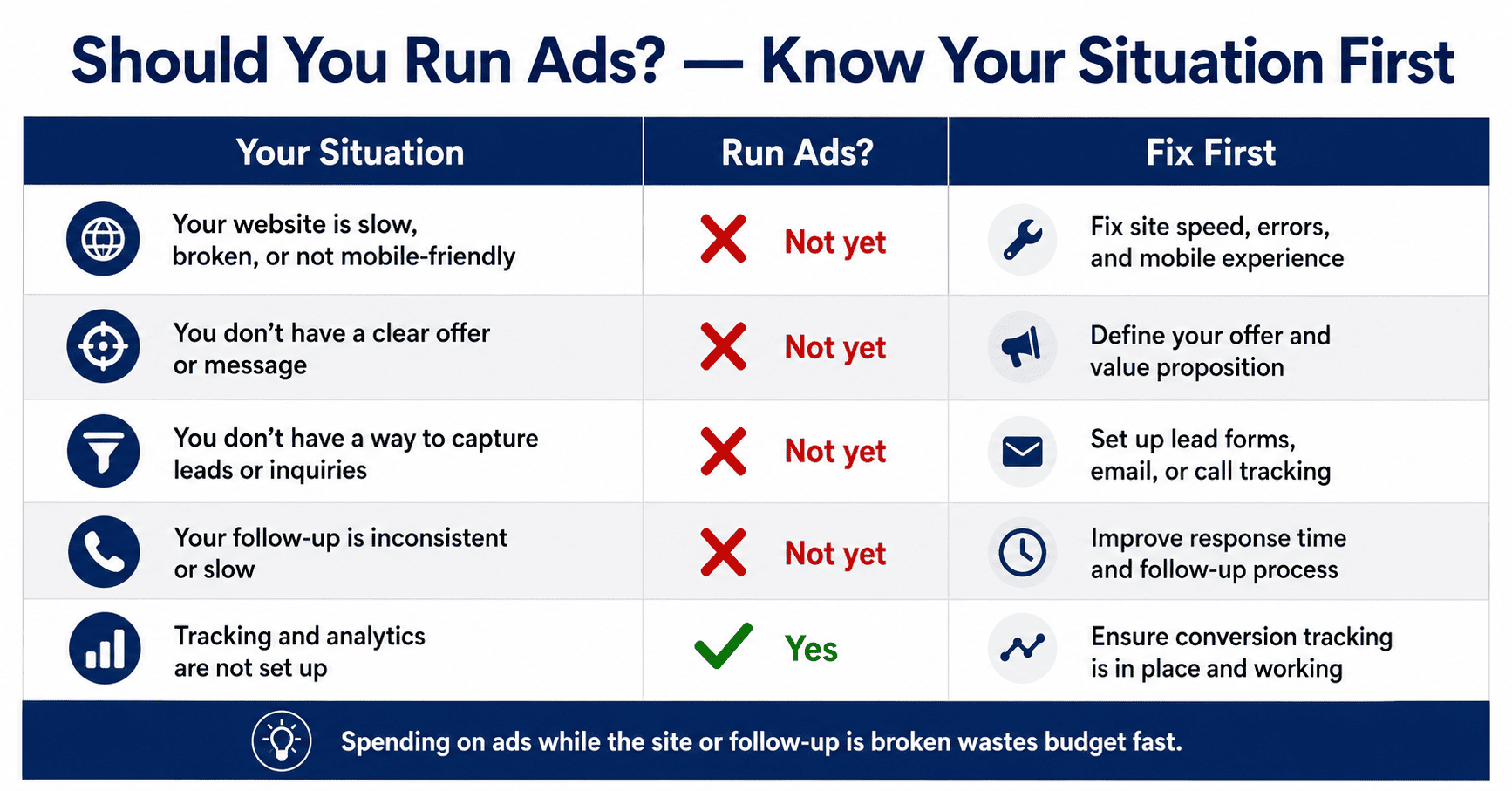
Spending on ads while the site or the follow-up is broken wastes budget fast. The traffic arrives and leaks straight back out.
Follow-up is the part people skip. Leads that arrive and sit unanswered convert worse than leads handled quickly, which is why CRM systems and business automation sit next to ad spend rather than after it.
Matching budget to stage
Ads work best inside a plan rather than as a standalone purchase. Our growth plan combines paid channels with the organic work that makes them cheaper over time. A full package covers more ground, and online marketing and SEO services set out every component in detail.
Plenty of businesses have already spent money badly here. If that sounds familiar, the common patterns behind wasting money on digital marketing services are worth checking before committing another budget.
The Bottom Line
Search ads capture demand that already exists, at the highest cost per click and the highest intent. Paid social on Meta platforms and LinkedIn creates demand before anyone searches, at a lower cost and with lower intent. Display keeps you present while people do something else and contributes more conversions than its click-through rate suggests. Each channel answers a different question, and the right one depends on whether your problem is capturing demand, creating it, or staying visible.
Picking correctly saves more money than optimizing a badly chosen channel ever will. That decision starts with an honest look at where your traffic and conversions actually break down, not with a platform recommendation.
Our digital marketing services cover paid channels alongside the organic and technical work that makes them perform. When you want a straight read on which channel fits your situation, book a 1.1 meeting with our team, and we’ll tell you where your budget belongs first.
FAQs
What are PPC advertising services?
PPC advertising services manage search campaigns where you pay each time someone clicks your ad. The work covers keyword research, bidding, ad copy, landing page alignment, and ongoing optimization. Ads appear above organic results when someone searches a term you’ve bid on.
What’s included in PPC advertising services?
Keyword research and selection, campaign structure, ad copywriting, bid management, negative keyword lists, landing page recommendations, conversion tracking setup, and regular reporting. Quality score diagnostics also fall in scope, since ad relevance and landing page experience affect performance.
What are paid social advertising services?
Paid social advertising services run campaigns on platforms like Facebook, Instagram, and LinkedIn. Targeting works through interests, behaviors, and demographics rather than search terms. The work includes audience building, creative production, testing, retargeting setup, and budget management.
What are online advertising services?
Online advertising services cover paid placements across search engines, social platforms, and display networks. The work includes choosing the right channel, building and targeting campaigns, managing budget, and tracking what converts. Most providers pair them with search engine optimization, since paid and organic reach the same people through different doors.
What are the best digital advertising services?
The best ones start by identifying which channel fits your situation instead of selling you a platform. They track cost per conversion rather than cost per click, align landing pages with the ads pointing at them, and connect ad spend to what happens after the click. No provider can guarantee a specific result, and any that does is worth avoiding.