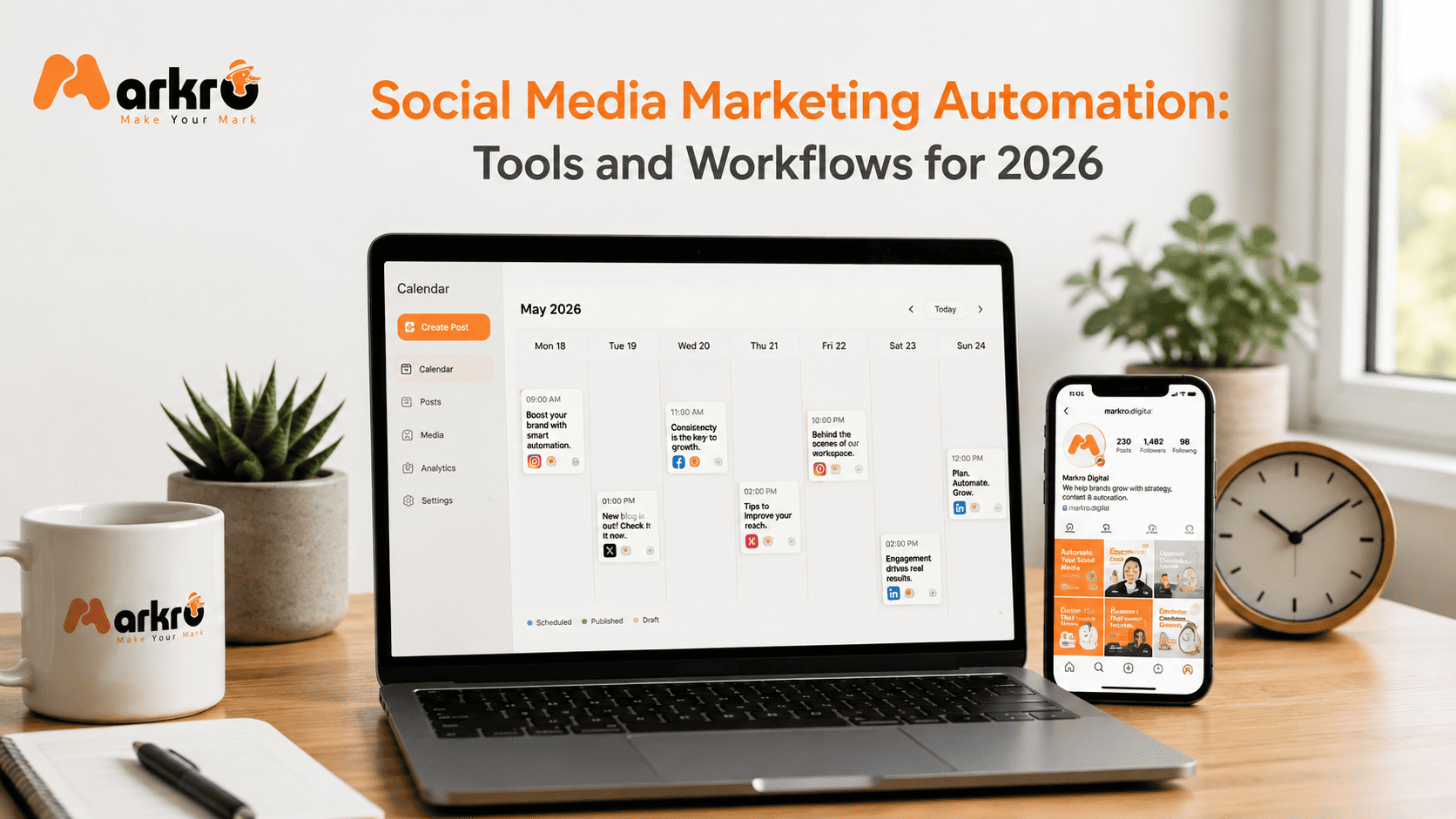
Social Media Marketing Automation: What to Automate and What to Leave Alone
Social media marketing automation handles the repetitive parts of posting, scheduling, and reporting so a team can spend its time on strategy and real conversations. Used well, it saves hours a week. Used badly, it turns a brand’s social presence into a robot nobody wants to follow.
The difference comes down to what you automate. Scheduling a week of posts in one sitting is a smart use of automation. Auto-replying to every comment with a canned message is not. Most businesses get this line wrong, either automating nothing and drowning in manual work, or automating everything and sounding like a machine. This post draws that line clearly, then shows the tools and workflows that hold up in 2026.
You’ll see what to automate, what to keep human, the workflows worth building, and where an agency fits when you’d rather not manage the stack yourself.
Quick Summary
Social media marketing automation is best used for scheduling, publishing, reporting, and monitoring, not for genuine engagement or strategy. The tools worth knowing in 2026 include Buffer, Hootsuite, Later, Sprout Social, and Metricool, with Zapier or Make wiring them to your other systems. Automate the repetitive work, keep the human parts human, and the time you save goes back into content and community.
What Social Media Marketing Automation Actually Does
Social media marketing automation is software that performs repetitive social media tasks without manual effort each time. It doesn’t run your strategy. It executes the parts of the work that don’t need a human touching them one by one.
The tasks automation handles well
Automation earns its place in the repetitive, rules-based work:
- Scheduling and publishing posts across several platforms from one place
- Queuing content in advance so the calendar stays full
- Monitoring mentions, keywords, and comments for things worth a response
- Reporting by pulling performance data into one dashboard
- Re-sharing evergreen posts that still perform
What it doesn’t do
Automation runs the machinery. It doesn’t supply the judgment. It won’t decide what your brand should say, write content that sounds like a person, or hold a real conversation with a customer. Those parts stay human, and the businesses that forget this are the ones whose feeds feel hollow.
That split is the whole point. Software handles volume and consistency. People handle voice and relationships. Our social media and content marketing services are built on keeping that line clear, so the automation saves time without flattening the brand.
What to Automate and What to Keep Human
The core rule of social media marketing automation is simple: automate the repetitive, keep the relational human. Get that split right and automation is a force multiplier. Get it wrong and it costs you the audience you were trying to reach.
Safe to automate
These tasks follow rules and don’t need a person each time:
- Post scheduling. Set the times, load the queue, let it publish.
- Cross-platform publishing. One post adapted and pushed to several channels.
- Performance reporting. Automatic weekly or monthly data pulls.
- Monitoring and alerts. Flagging mentions or keywords for a human to review.
- Evergreen recycling. Re-sharing proven content on a schedule.
Keep human
These need judgment, voice, or a real relationship:
- Replies to real comments and messages. A canned answer to a genuine question reads as dismissive.
- Content strategy. What to post, and why, is a decision, not a task.
- Crisis response. Anything sensitive needs a person reading the room.
- Community building. Relationships don’t automate.
The failure mode to avoid is treating the feed like a broadcast channel. Social platforms reward two-way interaction, and automation that removes the human from every exchange works against that. Keep the person in the loop where the loop matters.
The Social Media Marketing Automation Workflows Worth Setting Up
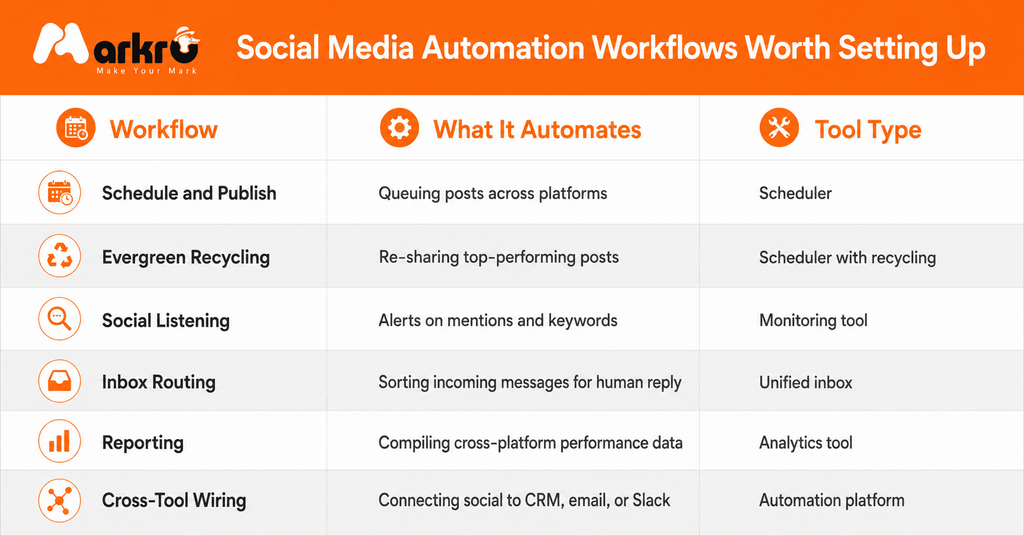
The value of social media marketing automation shows up in specific, repeatable workflows. These are the ones that save the most time for the least risk of sounding robotic.
Core workflows
Here’s how the main workflows break down and which type of tool handles each:
Setting them up in order
Build these in sequence rather than all at once:
- Start with scheduling. It delivers the biggest time saving and carries the least risk.
- Add reporting next. Automatic data pulls free you from manual spreadsheet work.
- Layer in monitoring. Alerts keep you responsive without watching feeds all day.
- Wire in the rest last. Cross-tool connections matter once the basics run smoothly.
Where your content lives affects how smoothly these run. A clean content management system makes publishing and tracking easier, while a messy one fights every workflow you try to build. The connective layer also reaches beyond social, which is why CRM systems and business automation sit next to your social stack, catching leads that come in through a comment or a message.
The Tools Behind Social Media Marketing Automation in 2026
The social media marketing automation tools worth knowing in 2026 fall into a few clear groups by job. Here’s what each does, using well-established platforms as examples.
Scheduling and publishing
These handle the core job of queuing and posting content:
- Buffer keeps scheduling simple, with pay-per-channel pricing that suits small businesses and creators. It supports the major platforms and includes a visual calendar and an AI assistant for drafting posts.
- Later started as an Instagram-first visual planner and still leans into that strength, with a drag-and-drop calendar, grid preview, and link-in-bio tools.
- Hootsuite handles publishing across many networks and adds team permissions and approval workflows, which fits larger teams and agencies.
Analytics and listening
These focus on measurement and monitoring:
- Metricool brings organic social, paid ads, and website analytics into one dashboard, priced by brand rather than per user.
- Sprout Social is a feature-rich platform with deep analytics and social listening, aimed at larger teams with the budget to match.
The connective layer
These wire your social tools to everything else:
- Zapier and Make connect social platforms to your CRM, email, or team chat, so an action in one tool triggers a step in another.
Picking a tool depends on your team size, budget, and goals, not on which one has the longest feature list. A solo creator needs a scheduler. A multi-brand agency needs analytics and permissions. Matching the tool to the job matters more than the brand name on it.
Where a Social Media Marketing Agency Fits Alongside Automation
Tools handle tasks. A social media marketing agency handles the parts tools can’t: strategy, voice, and the judgment to know what to automate in the first place. Automation and an agency aren’t alternatives. They work together.
What an agency adds that tools can’t
Software schedules a post. It doesn’t decide the post is worth making. An agency brings the layer above the tools:
- Strategy. The plan that decides what gets scheduled and why.
- Content and voice. Writing that sounds like a brand, not a bot.
- Setup and management. Building the automation stack so it runs without breaking.
- The human parts. Real engagement and community work that automation should never touch.
An agency also keeps the automation honest. Left alone, automated posting drifts toward filler because filling the calendar is easier than filling it well. A digital marketing expert team keeps the strategy tight and the automation serving it, rather than the other way around.
This connects to the wider picture too. Social rarely runs alone, so it sits inside a broader plan managed through social media management rather than as an isolated stack of tools.
Content Automation and Where a Content Marketing Agency Adds Value
Content automation can schedule and distribute content, but it can’t create content worth distributing. This is where a content marketing agency earns its place, supplying the strategy and writing that automation then carries.
What content automation can and can’t do
Automation moves content. It doesn’t originate from it.
- Can do: schedule posts, distribute across channels, recycle evergreen pieces, and report on what performs.
- Can’t do: decide what to write, produce content that reads like a person, or judge whether a piece is any good.
The risk with content automation is volume without value. A tool can publish a high volume of posts, but if those posts say nothing, the automation just scales the problem. Google’s guidance is clear that producing large volumes of low-value content to game rankings works against you, no matter how it’s made.
That’s the gap a content team fills. We covered why a content marketing agency ties strategy and creation together rather than treating content as something you can automate end-to-end. The automation handles distribution. The people handle the part that makes distribution worth doing.
Choosing Social Media Marketing Agency Services vs. Doing It In-House
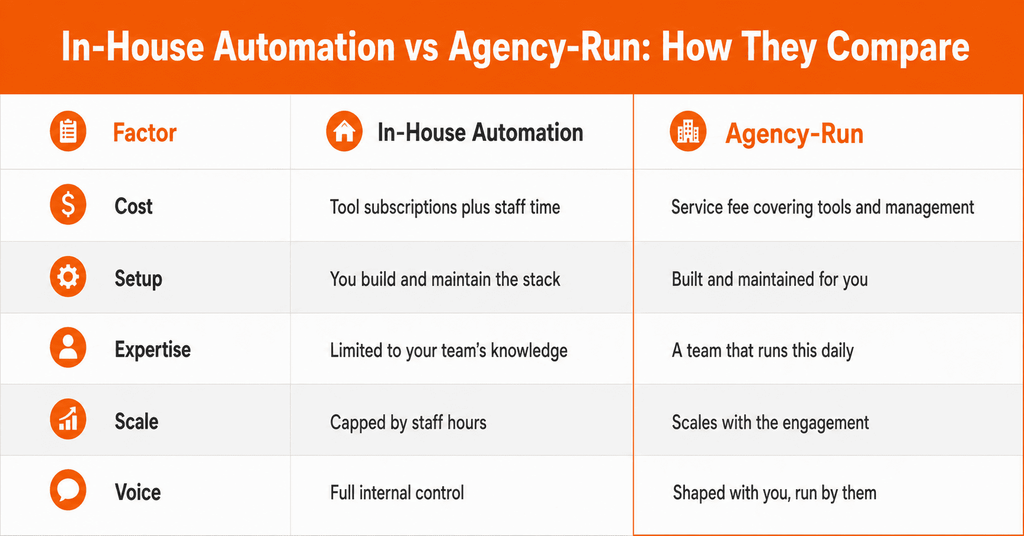
The choice comes down to running social media marketing agency services or building the automation stack in-house. Both work. The right one depends on your team, budget, and how much of this you want to own.
Here’s how the two compare:
How to decide
A few signals point one way or the other:
- Go in-house when you have the time, the skill, and a workload small enough for one person to manage the tools.
- Go with an agency when social is a real growth channel, the workload has outgrown your team, or you want expertise you don’t have on staff.
- Consider a hybrid where an internal owner handles day-to-day posting and an agency sets the strategy and builds the automation.
Whichever way you go, the same rule holds. No tool and no agency can promise a specific follower count or a viral post. Anyone guaranteeing that is selling something. What good content marketing companies offer instead is a clear plan, transparent reporting, and automation that serves the strategy rather than replacing it.
The Bottom Line
Social media marketing automation is a tool, not a strategy. It handles scheduling, publishing, reporting, and monitoring well, and it should never touch genuine engagement, voice, or the decisions behind what you post. The tools worth knowing in 2026, from Buffer and Later to Hootsuite, Sprout Social, and Metricool, all do the same core job: they save time on the repetitive work so people can spend it where it counts.
The businesses that win with automation are the ones that draw the line clearly. They automate the machinery and keep the human parts human. The ones that struggle either automate nothing and burn out on manual work, or automate everything and lose the audience they were building.
If your social media feels like a chore or a robot, the fix is usually the right split between automated and human, backed by a real plan. Our social media and content marketing services build that balance, from strategy through to the tools that run it. When you want a straight read on what to automate and what to keep human, talk to our team and we’ll show you where to start.
FAQs
What is social media marketing automation?
Social media marketing automation is software that handles repetitive social tasks without manual effort each time. It covers scheduling, publishing, monitoring, and reporting across platforms. The goal is saving time on routine work so people can focus on strategy and real engagement, which automation can’t replace.
Can you automate social media marketing?
You can automate parts of it, but not all of it. Scheduling, publishing, reporting, and monitoring automate well. Strategy, content creation, genuine replies, and community building need a person. The best approach automates the repetitive work and keeps the relational and creative parts human.
What should you not automate on social media?
Don’t automate real replies, content strategy, crisis response, or community building. Auto-responding to genuine comments makes an audience feel ignored, and automated strategy produces filler. Automate the routing and scheduling, then have a person handle anything that needs judgment, voice, or a real relationship.
What are the best social media marketing automation tools in 2026?
Well-established tools in 2026 include Buffer and Later for scheduling, Hootsuite for team publishing, Metricool and Sprout Social for analytics and listening, and Zapier or Make for connecting social to other systems. The right one depends on your team size, budget, and goals, not the feature count.
Does social media automation hurt engagement?
It hurts engagement only when it replaces genuine interaction. Automating scheduling and reporting frees up time that can go into real engagement, which helps. Automating actual conversations, like auto-replies to real questions, damages it. Used for the repetitive work and not the relational work, automation supports engagement rather than harming it.