What Is Online Reputation Management, And Why Your Business Can’t Ignore It
TL;DR
Online Reputation Management (ORM) is the process of monitoring, influencing and improving your company’s online presence across Google search results, review sites and social media . By 2026, more often than not, your online brand image will be the first impression a potential customer will have before they even contact you. A single wave of unchecked negative reviews or damaging press can undermine confidence, harm conversions and affect search visibility. In this article we will look at what ORM is, why it is important, how it works and the strategies and tools that businesses use to protect and repair their online reputation.
What is Online Reputation Management?)
Online reputation management is the practice of managing the online image of an individual, brand or business. This includes everything that comes up when someone searches your name: Google results, review sites, social media profiles, news articles, forums, and third-party directories.
ORM is not the same as public relations. PR manages the message you send out. Online reputation management manages what people find when they go looking, and those two things are often very different.
A business can run outstanding PR campaigns and still lose customers because their Google My Business listing is drowning in one-star reviews. A professional can have a stellar offline track record and still be overlooked because of a damaging article that ranks on page one of search results.
That gap, between the reputation you believe you have and the reputation that exists online; is exactly what online reputation management is designed to close.
Why Online Reputation Management Matters More Than Ever
The numbers behind ORM are not abstract. They directly connect to revenue.
According to research cited by HubSpot, the vast majority of consumers read online reviews before making a purchase decision, and most trust those reviews as much as personal recommendations. A business with a strong review profile and positive search presence consistently outperforms competitors with better products but weaker online brand images.
Here is why online reputation management is now a business critical function:
Search Results Are Your First Impression
Before a prospect calls you, visits your website, or reads your proposal, they search your name. The first page of results, whether it shows glowing reviews and authoritative mentions or complaint threads and negative press, is your de facto introduction. You do not control what they find unless you actively manage it.
Negative Reviews Compound Over Time
One negative review left unaddressed does not just sit there. It gets seen by every new visitor. It shapes the sentiment of the listing. If other negative reviews come in and are left unaddressed, the pattern tells potential customers and Google that the business is unresponsive and potentially unreliable.
Good online reputation management breaks that cycle, through professional responses, proactive review generation and ongoing monitoring.
Trust Is the Conversion Factor
For service businesses in particular, trust is the primary conversion driver. Customers are not just buying a product, they are deciding whether to hand their money, their data, or their business outcomes to your team. A clean, positive, actively managed online reputation is the fastest trust signal available.
The Core Pillars of an ORM Strategy
A complete ORM strategy operates across four interconnected areas:
1. Reputation Monitoring
What you are not measuring, you cannot control. Monitoring your reputation means tracking all mentions of your company, executives and products in:
- Google search results
- Google My Business reviews
- Third-party review platforms (Trustpilot, Yelp, G2, Capterra)
- Social media (mentions, tags, comments)
- News articles and blogs
- Industry forums and Reddit threads
Tools such as Google Alerts, Mention and Semrush’s brand monitoring capabilities give businesses real-time visibility into what is being said about them online. According to Sprout Social, social listening is directly relevant to reputation monitoring because it helps you catch negative sentiment before it turns into a public crisis.
This ties directly into social media management, because social is where brand narratives really take shape and spread widest.
2. Review Management and Response
Online review management is not just about collecting five-star ratings. It’s about showing all potential customers that are reading your reviews before making a purchase, that you are responsible, responsive and professional.
Some best practices for review management include:
- Responding to every review: positive and negative, in 24-48 hours
- Addressing negative reviews specifically: not a generic apology but an explicit acknowledgment of the problem and a way to fix it
- Requesting reviews proactively: from satisfied customers via post-service follow-ups, without incentivizing or manipulating the result
- Flag policy-violating reviews: fake reviews, spam, or reviews that violate platform guidelines can be reported for deletion (legitimate negative reviews cannot be deleted)
You want to build a review profile that shows volume and recency, and how professionally engaged you are – all of which adds credibility for both customers and search algorithms.
3. Search Result Suppression and Promotion
This is where online reputation management and search engine optimization intersect most directly. When a damaging article, complaint thread, or negative listing ranks on the first page for your brand name, the ORM response is to outrank it, not remove it.
As Search Engine Journal outlines, suppression strategies involve creating and optimizing high-authority positive content, press releases, guest articles, social profiles, video content, and directory listings, that earns stronger rankings than the negative result and pushes it off page one.
This is reputation repair in its most technical form, and it is why ORM and SEO cannot be treated as separate disciplines. They operate on the same algorithm and compete for the same positions.
Moz notes that domain authority, link profiles, and content freshness all factor into how quickly suppression campaigns move negative results down the rankings. There are no quick fixes but a consistent approach can measure results.”
4. Proactive Brand Building
The most sustainable way to manage a brand’s reputation is not reactive, but rather a constant, proactive process to develop an online presence so strong that there is nowhere for the occasional negative content to go.
This means:
- Creating regular, excellent content that promotes your brand name
- Building authoritative profiles on LinkedIn, Google Business, and industry directories
- Earning media mentions and backlinks from credible publications
- Maintaining active, professionally managed social channels
- Collecting and showcasing genuine customer testimonials
Businesses that invest in proactive business reputation management before a crisis hits are dramatically better positioned when a negative event occurs. Their positive content buffers and dilutes the impact, and makes suppression faster.
This proactive approach is a core component of any complete digital marketing services strategy.
Personal Reputation Management vs Business Reputation Management
While the tools and tactics overlap, personal reputation management and business reputation management have distinct priorities.
Personal ORM typically focuses on:
- Managing results that appear when a full name is searched
- Suppressing old or outdated content (past employers, legal records, old press)
- Building a professional online presence (LinkedIn, personal website, authored content)
- Managing search results for executives and public-facing professionals
Business ORM focuses on:
- Review platform management across Google, Trustpilot, Yelp, and industry-specific sites
- Brand mention monitoring and response
- Crisis management for negative press or viral complaints
- Search result suppression for damaging content about the company
Both of these have the same discipline underneath: watching consistently, creating strategically, and managing responses professionally.
Google Reputation Management: The Priority Channel
For most businesses, reputation wars are won or lost on Google. Google reputation management has three major areas:
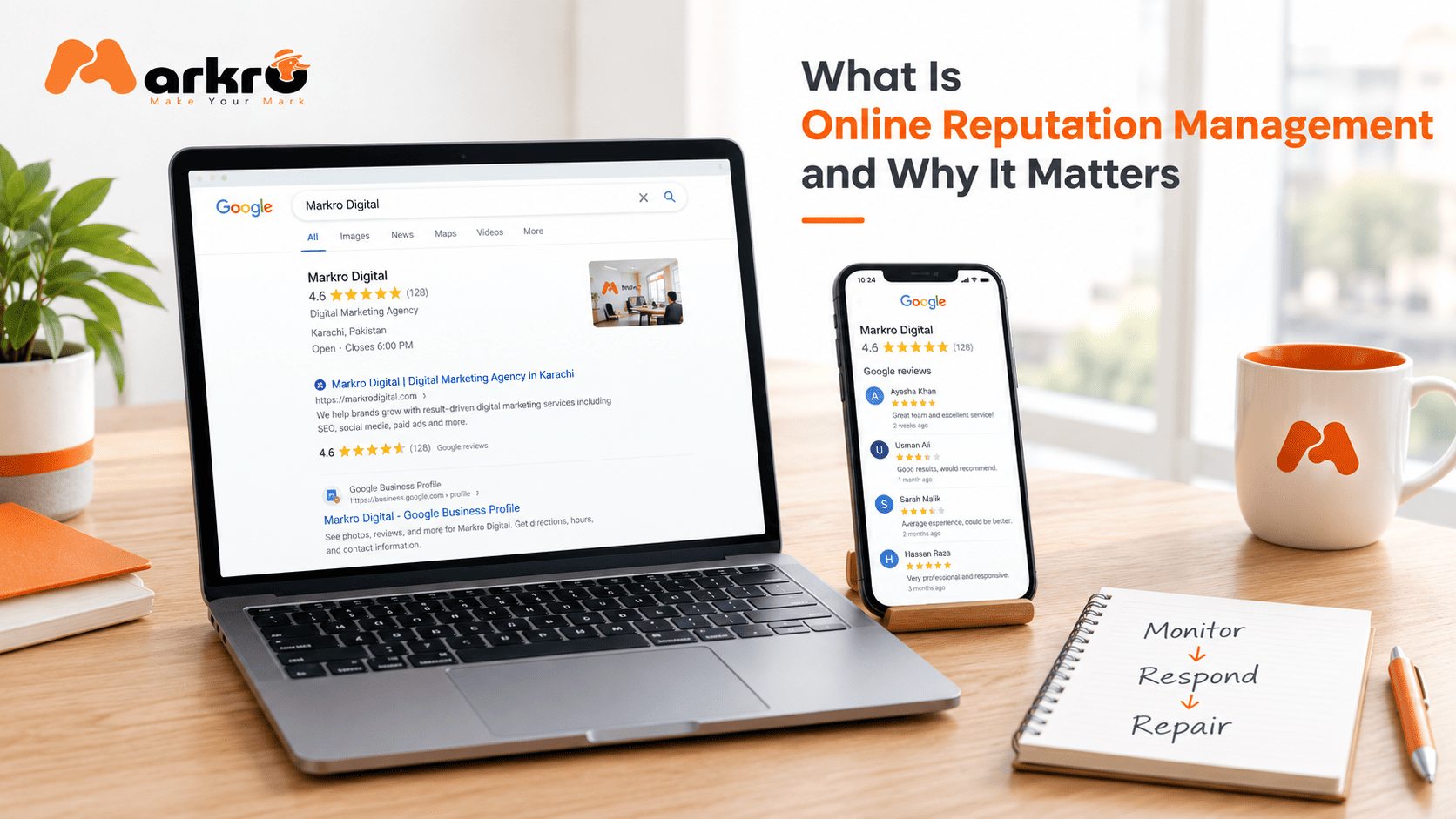
Google My Business (Google Business Profile). This is what happens when you do a local search or bring up a map. It displays star ratings, review counts, photos and details about the business, all before the user clicks on anything. An unmanaged or poorly rated GMB profile directly kills click-through rates and conversions.
Google Search Results (Page 1): The ten organic results that appear when someone searches for your brand name are the most visible form of your public reputation. ORM fills these positions with positive, authoritative content.
Google Review Removal Policy: Reviews that breach Google’s content policies are removed. These include fake reviews, spam, off-topic content and reviews with prohibited material. You can’t request to have genuine negative reviews taken down, even if they seem very unfair. The appropriate response is a professional, empathetic, public response that future readers can see.
Reputation Monitoring Tools Worth Knowing
For businesses managing ORM in-house or working with an agency, these tools are the standard starting point:
- Google Alerts: Free. Tracks web mentions of any keyword, including your brand name
- Mention: Real-time monitoring across web and social with sentiment analysis
- Semrush Brand Monitoring: Tracks mentions, backlinks, and sentiment at scale
- ReviewTrackers: Aggregates reviews from 100+ platforms into one dashboard
- Sprout Social: Social listening and brand monitoring with response management built in
The right combination depends on your business size, the volume of reviews you receive, and whether your ORM strategy is managed in-house or through a professional service.
When to Work With a Professional ORM Service
Basic reputation monitoring and review response are manageable in-house for most small businesses. However, professional online reputation management services become essential when:
- A damaging article or news story ranks on page one for your brand name
- A coordinated campaign of fake negative reviews is targeting your business
- Your review average has dropped significantly and is suppressing conversions
- A past event, legal, financial, or operational, is creating persistent negative search results
- You are preparing for a funding round, acquisition, or high-profile partnership where due diligence will include an online reputation audit
Professional ORM services combine technical SEO, content strategy, PR outreach, and review management into a coordinated campaign, working across a timeline of months, not days.
If your business is at any of these inflection points, the cost of inaction is almost always higher than the cost of professional intervention.
Your online reputation is working for you,or against you, right now. If you want a clear picture of where your business stands and what to do about it, get a free consultation with Markro Digital. We help businesses take control of their digital presence before a reputation issue becomes a revenue problem.
Frequently Asked Questions
Q1. Define Online Reputation Management (ORM).
Online Reputation Management (ORM) is the practice of managing, controlling and improving the online image of a business or person in Google search results, review Your Websites and social media channels.
Q2. Why reputation management is important for business?
Your online reputation is directly related to how much customers trust you, what purchases they make and how visible your search results are. A single round of negative reviews or bad press can have a huge impact on sales if it is not addressed.
Q3: How can I monitor my online reputation?
Use tools like Semrush, Mention and Google Alerts to monitor what is being said about your brand online. Regularly check review sites like Yelp, Google and Trustpilot for new reviews.
Q4: Can bad reviews be removed from Google?
Reviews are only removed if they violate Google’s policies such as containing spam, offensive language or fraud. You can’t delete legitimate negative reviews, but you can respond to them professionally with a public statement.
Q5: When can I expect to see results from online reputation management?
Yes, if the problem is serious enough. In weeks you can make slight improvements, but it takes months of persistent work to repair a seriously damaged reputation.
Q6. ORM vs SEO – What is the difference?
SEO is about ranking higher in search results for targeted keywords. The primary goals of ORM are to manage what content appears when someone searches for a person’s brand name, to promote good results and to limit bad ones.
Q7: Can a business manage their own online reputation?
Yes, for basic monitoring and response reviews. But if you have a serious reputation problem, bad press or want to suppress damaging search results, you need to go with a professional ORM service.