
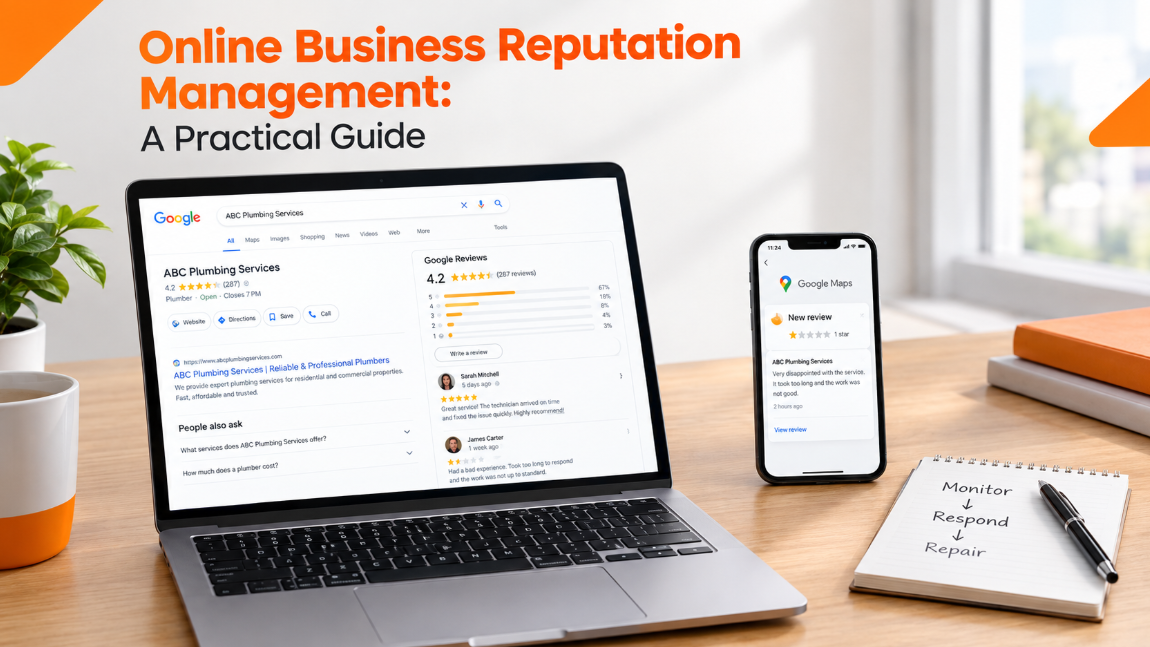
A Step-by-Step Approach to Online Business Reputation Management
A restaurant owner checked his Google search results one afternoon and found a one-star review sitting at the top, unanswered, six months old. Three potential customers mentioned it directly when they called to ask if the kitchen had “fixed the issue.” He had no idea what issue they meant.
That single review, left unaddressed, shaped how strangers judged his business before they ever walked through the door. Online business reputation management is what closes that gap between what a business actually delivers and what search results and review platforms tell people about it. Most business owners only think about it after something has already gone wrong.
This guide covers what online business reputation management actually involves, how to monitor it, and what to do when a review or mention threatens to damage a business’s standing online.
TL;DR: Online business reputation management is the process of monitoring, influencing, and improving how a business appears across Google search results, review platforms, social media, and news mentions. It combines active monitoring, consistent customer review response, targeted content publishing, and, where needed, professional reputation repair. Google removes only reviews that violate its policies, so legitimate negative feedback has to be managed through response and positive review volume instead. Markro Digital treats reputation management as an ongoing function, not a one-time cleanup project.
What Is Online Business Reputation Management?
Online business reputation management is the process of monitoring, influencing, and improving how a business appears online, across Google search results, review platforms, social media, and news mentions. It covers everything a potential customer might see before they decide whether to trust a business enough to call, visit, or buy.
The practice sits at the intersection of customer service, search visibility, and public perception. A business with excellent service but no review strategy can still look worse online than a mediocre competitor who responds to every review and keeps their profile active.
Why Online Business Reputation Management Matters
A business’s online reputation directly affects customer trust and buying decisions. Most consumers read reviews before choosing a business, which means a poor reputation translates directly into lost revenue, regardless of the actual quality of the product or service behind it.
Pro tip: Search a business’s own name in an incognito browser window every month. That’s the exact first impression a new customer gets, unfiltered by personalization or browsing history.
Core Components of a Reputation Management Strategy
A working reputation management strategy is built from four connected activities, not a single fix applied once.
| Component | What It Involves |
| Monitoring | Tracking mentions, reviews, and search results continuously |
| Response | Replying to reviews and feedback, positive and negative |
| Content | Publishing positive, accurate content that ranks alongside search results |
| Repair | Addressing serious damage through a structured recovery plan |
Each component depends on the others. Monitoring without response catches problems but doesn’t fix them. Response without monitoring means issues sit unnoticed for months, the same gap that cost the restaurant owner three customers before he even knew there was a problem.
Online Reputation Monitoring: Seeing the Full Picture
Online reputation monitoring starts with knowing where a business’s name actually appears. Tools like Google Alerts, Mention, or Semrush Brand Monitoring track mentions across the web, while checking Google, Yelp, Trustpilot, and Facebook reviews directly catches new feedback as it happens.
What to Monitor Regularly
- New reviews across every platform a business is listed on, not just Google
- Direct mentions in local news, forums, and industry publications
- Search results for the business’s own name, checked from a logged-out browser
- Social media comments and tags referencing the business
Monitoring only becomes useful when it’s checked on a set schedule. A weekly review sweep catches problems early enough to respond before they shape a stranger’s first impression.
Google Review Management: The Highest-Impact Piece
Google review management carries outsized weight because Google’s local pack and search results are usually the first place a potential customer looks. Markro Digital’s guide to ranking higher in Google Maps covers how review volume and recency directly influence local search visibility, on top of shaping customer trust.
Handling Negative Review Removal Requests
Google only removes reviews that violate its policies: fake, spam, or clearly offensive content. Legitimate negative reviews, even harsh or unfair ones, cannot be deleted through a removal request. The only reliable path is addressing them with a calm, professional public response that potential customers can read alongside the complaint.
Customer Review Response That Actually Works
A calm, professional customer review response shows future customers that a business takes feedback seriously. It can neutralize much of a negative review’s impact and demonstrate the kind of service someone can expect if a problem does come up.
- Respond within 24 to 48 hours, before the review sits unanswered.
- Acknowledge the specific issue without being defensive.
- Offer to resolve the matter directly, off the public thread.
- Keep the tone professional even when the review itself isn’t.
Pro tip: Never argue with a reviewer in the public response. A calm, factual reply reads as credible to everyone who sees it later; an argument reads as a red flag.
Brand Reputation Management Beyond Reviews
Brand reputation management extends past individual reviews into how a business is discussed on social media, in news coverage, and across search results as a whole. A business can have strong reviews and still face reputation damage from an unaddressed social media complaint or an outdated news mention still ranking on page one.
Search Result Reputation Management
Search result reputation management focuses specifically on what appears when someone searches a business’s name directly. This means publishing consistent, accurate content (a well-maintained website, active social profiles, and positive press) that ranks alongside or above any negative content already in the results.
Online brand management, taken as a whole, is what keeps a business’s public identity consistent across every channel a potential customer might check.
Business Reputation Repair: When Damage Is Already Done
Business reputation repair applies when a business is facing more serious damage than a single unanswered review, a cluster of negative feedback, a public complaint that went viral, or an outdated news story still ranking near the top of search results.
A Structured Repair Approach
- Address the root cause first; no reputation strategy works if the underlying problem repeats.
- Respond publicly and professionally to every piece of negative feedback still visible.
- Actively request reviews from recent satisfied customers to shift the overall balance.
- Publish fresh, accurate content regularly to strengthen what ranks in search results.
Minor issues can show improvement within weeks. Seriously damaged reputations typically require six to twelve months of consistent effort: publishing positive content, earning new reviews, and steadily pushing outdated negative results further down the page.
ORM Services vs Traditional PR
ORM services and traditional PR solve related but different problems. PR manages public perception through media coverage and press relationships. ORM focuses specifically on what appears in search results and on review platforms when someone searches a business’s name directly.
A business recovering from a serious incident often needs both: PR to manage the broader narrative, and ORM services to make sure the search results and review platforms reflect that recovery once the immediate story fades.
Local Business Reputation: Why It Compounds
Local business reputation carries extra weight because local search results and review platforms directly influence which business a nearby customer chooses. Consistent review volume and active social media management both feed into how a local business appears across the platforms customers actually check before visiting.
A local business that keeps its reputation strategy active, responding to reviews, monitoring mentions, and publishing consistent updates, tends to compound that advantage over competitors who only pay attention after a crisis.
How Online Business Reputation Management Connects to SEO
Reputation signals and search visibility reinforce each other directly. Review volume and response consistency feed into local ranking factors, while search engine optimization work strengthens the accurate content that needs to outrank any negative mentions in search results.
Reputation and visibility rarely improve in isolation. A business investing in one usually needs the other working alongside it to see the full effect.
How Markro Digital Approaches Reputation Management
At Markro Digital, reputation management runs as an ongoing function within digital marketing services, monitoring, response, and content working together instead of getting handled as a one-time cleanup after damage has already spread.
Online business reputation management works best when it’s treated as routine maintenance rather than emergency response. A business that monitors weekly, responds within a day or two, and keeps fresh content flowing rarely faces the kind of crisis that takes months to repair.
The businesses that struggle most are the ones that only start paying attention once a bad review is already sitting at the top of their search results. By then, the fix takes longer and costs more than consistent management would have. Get a free call to talk through a reputation strategy, or see the portfolio for documented results.
Author: Mudassir Ali, writes on reputation strategy and local search visibility for Markro Digital, helping businesses protect what customers see before they ever make contact.
Frequently Asked Questions: Online Business Reputation Management
What is online business reputation management?
It is the process of monitoring, influencing, and improving how a business appears online, across Google search results, review platforms, social media, and news mentions.
Why does online reputation management matter for businesses?
A business’s online reputation directly affects customer trust and buying decisions. Most consumers read reviews before choosing a business, so a poor reputation means lost revenue.
How do I monitor my business reputation online?
Use tools like Google Alerts, Mention, or Semrush Brand Monitoring to track mentions. Check Google, Yelp, Trustpilot, and Facebook reviews regularly for new feedback.
Can negative Google reviews be removed?
Google only removes reviews that violate its policies: fake, spam, or offensive content. Legitimate negative reviews cannot be deleted but should be addressed with a professional public response.
How long does it take to repair a damaged business reputation?
Minor issues can show improvement within weeks. Seriously damaged reputations typically require six to twelve months of consistent effort: publishing positive content, earning reviews, and suppressing negative results.
What is the difference between ORM and PR?
PR manages public perception through media and press. ORM focuses specifically on what appears in search results and on review platforms when someone searches your business name.
Should I respond to negative reviews publicly?
Yes. A calm, professional response shows potential customers that you take feedback seriously. It can neutralize the impact of a negative review and demonstrate good customer service.