
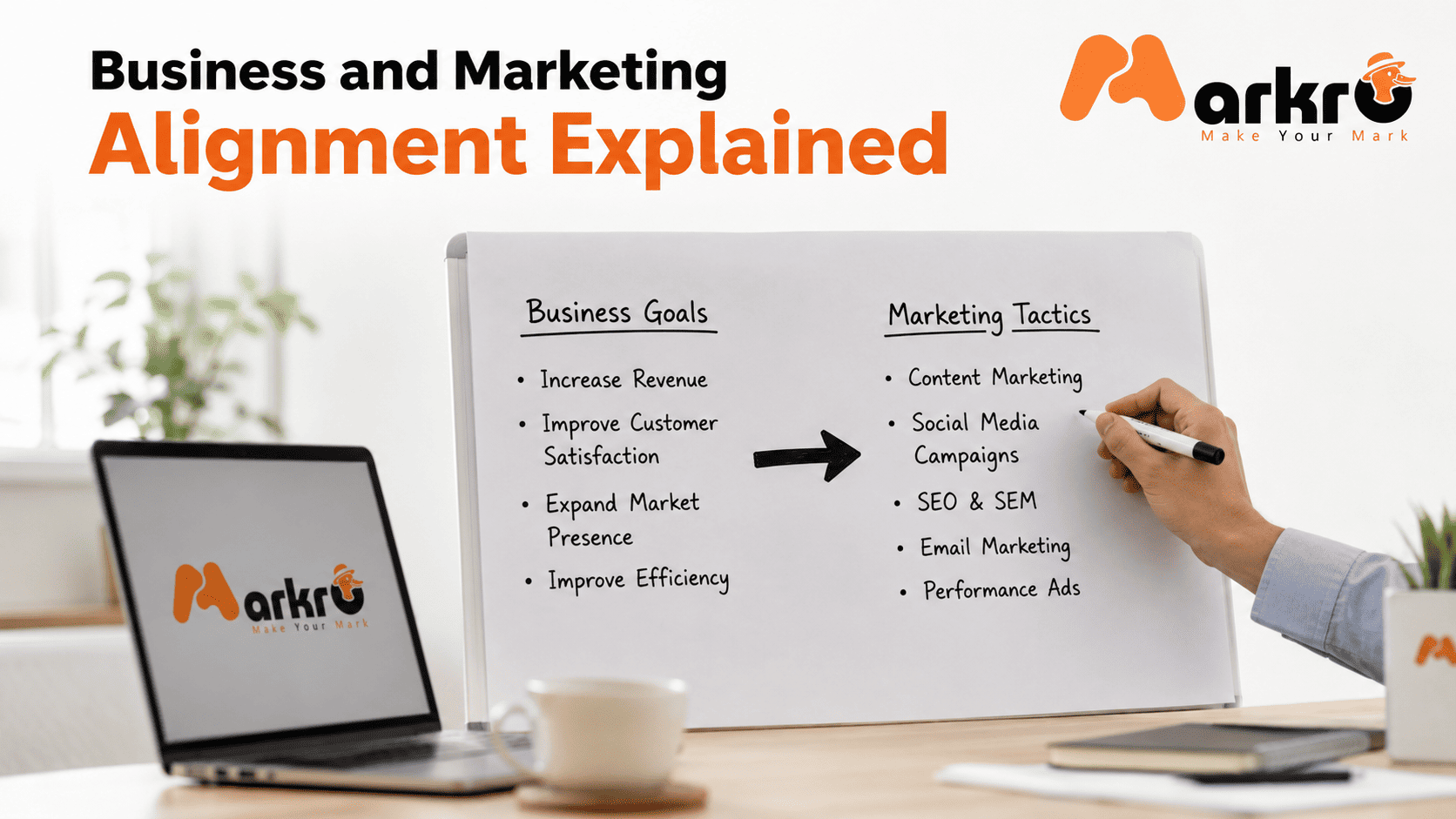
Business and Marketing Alignment: Getting Every Channel to Pull the Same Way
Business and marketing alignment is what happens when your company’s goals and your marketing work point in the same direction. Most businesses assume they have it. Far fewer actually do.
The gap shows up in a familiar way. Leadership sets a revenue target. Marketing runs campaigns measured by clicks and follower counts. Sales chases quarterly numbers.
Each team works hard, but the effort doesn’t compound because nobody agreed on the same destination first. That disconnect is expensive, and it rarely announces itself until the budget review.
This post covers what alignment actually means, why strategy has to come before tactics, and how to build a planning process that keeps the two connected over time.
Quick Answer
Business and marketing alignment means every marketing action traces back to a business goal. It breaks down when teams measure different things: leads versus revenue, clicks versus closed deals. The fix isn’t more meetings. It’s sequencing, setting business objectives first, deriving marketing goals from them, and choosing tactics last. Aligned teams waste less and grow faster.
What Business and Marketing Alignment Actually Means
Business and marketing alignment is the connection between where a company is going and how its marketing gets it there. The two are separate jobs that have to answer to each other.
Business strategy defines direction: what the company wants to achieve, which customers it serves, and where it puts its resources. Marketing strategy defines execution: how to reach those customers and move them toward those goals.
When the two connect, every campaign, blog post, and ad has a reason to exist that traces back to a business outcome. When they don’t, marketing drifts toward activity for its own sake.
The difference isn’t effort. It’s structure. That structure is exactly what marketing strategy services are built to provide: which channels matter for a specific business, in what order, and how each one supports the others instead of competing for the same budget.
When Marketing Alignment Breaks Down, Budgets Leak
Marketing alignment fails quietly. Nothing crashes. The website, the ads, and the social accounts all keep running, just toward different goals, and the waste adds up out of sight.
The two-metric problem
Marketing measures success one way. Sales measures it another.
- Marketing counts leads, impressions, engagement, and reach.
- Sales counts closed deals and quota.
When those definitions diverge, every downstream process breaks. Marketing points to lead volume as proof it’s working. Sales points to low conversion as proof it isn’t. Both are looking at the same funnel and drawing opposite conclusions.
What the disconnect costs
The numbers here are consistent, which is rare in marketing research. ZoomInfo’s roundup of sales and marketing alignment statistics reports that tightly aligned organizations see 36% higher customer retention and 38% higher sales win rates, while only 8% of companies report strong alignment between the two functions.
The cost of getting it wrong is just as measurable:
| Aligned teams | Misaligned teams |
| Higher retention and win rates | Wasted content and unspent effort |
| Shared definition of a good lead | Leads that arrive and never convert |
| Marketing tied to revenue | Marketing measured on vanity metrics |
| Budget concentrated on what works | Spend spread across disconnected tactics |
This is the coordination problem behind most underperforming marketing. A business runs ads for a week, pauses them, hires a freelancer for SEO, drops that when a new tactic appears, and redesigns the site in between. Each decision made alone. None connected to the last. Strong digital marketing services fix that by tying the pieces to one plan rather than selling them as separate parts.
Strategy Comes Before Tactics, Not the Other Way Around
The most common planning mistake is starting with tactics and working backward. A business picks channels first, then looks for goals those channels could serve. Business and marketing alignment requires the reverse order.
The sequence runs like this. Business objectives come first. Marketing goals derive from those objectives. Tactics are the last decision, not the first.
That means getting specific before a single campaign is planned. Not “grow revenue”, but a defined target like a 20% increase in qualified leads over two quarters. Not “build awareness”, but recognition in the exact segment where sales sees high-intent prospects who aren’t converting. The sharper the goal, the more direct the marketing built to serve it.
Search visibility is a good example of a tactic that only works when it serves a defined goal. A business investing in search engine optimization without knowing which customers it’s trying to reach ends up ranking for terms that bring traffic but no revenue. The tactic isn’t wrong. It just wasn’t pointed at anything.
Aligning Sales and Marketing Around One Definition of a Lead
The single biggest source of friction is a disagreement nobody names out loud: what counts as a good lead. Aligning sales and marketing starts with settling that question.
Here’s how the disconnect plays out. Marketing generates leads and calls them qualified. Sales works a few, finds them cold, and stops trusting the rest. Marketing sees its leads ignored and assumes sales isn’t following up. Both are right, and both are measuring against a definition the other never agreed to.
The Growth Syndicate’s guide to sales and marketing alignment points to the scale of the waste: a large share of B2B marketing content goes unused by sales because it doesn’t match real buyer conversations, and most marketing-generated leads never convert, often because handoff and nurturing break down. The root cause in both cases is the same missing agreement.
Fixing it takes a few concrete steps:
- Write one shared definition of a sales-ready lead, built by both teams.
- Agree on the handoff. When does a lead move from marketing to sales, and what information travels with it?
- Close the loop. Sales tells marketing which leads converted, so marketing can make more of them.
That handoff also needs infrastructure. Leads that arrive and sit unanswered convert worse than leads handled quickly, which is why CRM systems and business automation sit at the center of a working handoff. The people running it matter too, and a digital marketing expert team keeps the definition and the follow-up consistent instead of letting each channel drift.
Turning Business Goals Into Metrics That Trace to Revenue
Once objectives are set, alignment lives or dies on one discipline: every marketing metric should have a traceable path to a business outcome. If it doesn’t, it’s measuring motion, not progress.
Here’s how that translation works in practice:
| Business goal | Marketing objective | What to track |
| Grow revenue 20% | 25% more qualified leads | CAC, conversion rate by funnel stage |
| Cut churn 10% | Re-engagement and loyalty program | Email re-engagement, customer lifetime value |
| Enter a new market | Awareness in that segment | Segment-specific reach and consideration |
The pattern is the same each time. The business goal sets the destination. The marketing objective is the route. The metric confirms you’re moving toward it, not just moving.
This is also where the wrong measurement causes real damage. When marketing is rewarded for lead volume alone and nobody connects those leads to revenue, the team optimizes for a number that looks good and means little. Where you publish and track this matters too, so the content management system behind your site should feed clean data into the picture, not fragment it.
Building a Business and Marketing Alignment Process That Holds
A strategy document in a shared drive isn’t alignment. Business and marketing alignment holds only when it runs as a repeatable process, not a one-time planning session.
A practical sequence looks like this:
- Understand the business. Goals, audience, current marketing, and the real constraints of budget and timeline.
- Research the market. Competitor positioning, audience behavior, and search demand, reviewed together.
- Define priorities. Rank opportunities by impact and feasibility. Tackle the highest first, not everything at once.
- Build the strategy. Turn priorities into a roadmap, with channels and sequence tied to specific objectives.
- Support the work. Connect the plan to the teams doing it: website, SEO, content, and branding.
- Measure and refine. Review performance against the original goals and shift when the data calls for it.
The discipline is resisting the pull to start with tactics. “What should we run this quarter” should always follow “what is the business trying to achieve,” never lead it.
Conditions shift mid-year, so the process has to flex. A plan set in January often needs adjustment by April, and that’s fine when the reviews are built in. The Growth Plan works this way, adding channels as priorities change rather than locking a business into a fixed list. Plenty of companies have skipped this and paid for it, which is the pattern behind wasting money on digital marketing services that never connected to a goal.
The Bottom Line
Business and marketing alignment isn’t a communication problem you solve with more meetings. It’s a sequencing problem. Business objectives come first, marketing goals derive from them, and tactics come last. Teams that get the order right measure the same outcomes, share one definition of a good lead, and spend their budget on work that compounds. Teams that skip it stay busy and wonder why the results stay flat.
The fix costs no more than the misalignment does. It’s the same budget and the same effort, pointed in one direction instead of several. That shift is usually the difference between marketing that looks active and marketing that moves the business.
Our marketing strategy services build that alignment from the first objective through to measurement. When you want a straight read on where your strategy and marketing have drifted apart, Contact Us, Our Team and we’ll show you where to start.
FAQs
What is business and marketing alignment?
It’s the connection between a company’s goals and its marketing work, so every campaign traces back to a business outcome. Business strategy sets the direction. Marketing strategy handles execution. Alignment means the two point the same way instead of running on separate tracks.
What is the difference between a business strategy and a marketing strategy?
A business strategy defines where the company is going: its goals, target customers, and priorities. A marketing strategy defines how to get there: how to reach and convert those customers. Both have to connect, or marketing produces activity with no traceable link to revenue.
How do you know if your marketing and business goals are misaligned?
Common signs include leads that don’t convert, sales teams ignoring marketing content, and reports full of clicks and impressions but no revenue impact. If you can’t draw a line from a marketing activity to a business outcome, the two are out of sync.
Why should strategy come before tactics?
Because tactics chosen without a goal serve nothing. Deciding on channels first, then hunting for objectives to justify them, is how budgets get wasted. Setting the business goal first tells marketing exactly what to build and how to measure whether it worked.
How often should you review marketing alignment?
At least quarterly. Business goals, market conditions, and performance data all shift during the year, and a plan set in January often needs adjustment by spring. Regular reviews keep marketing pointed at current objectives instead of last quarter’s.