
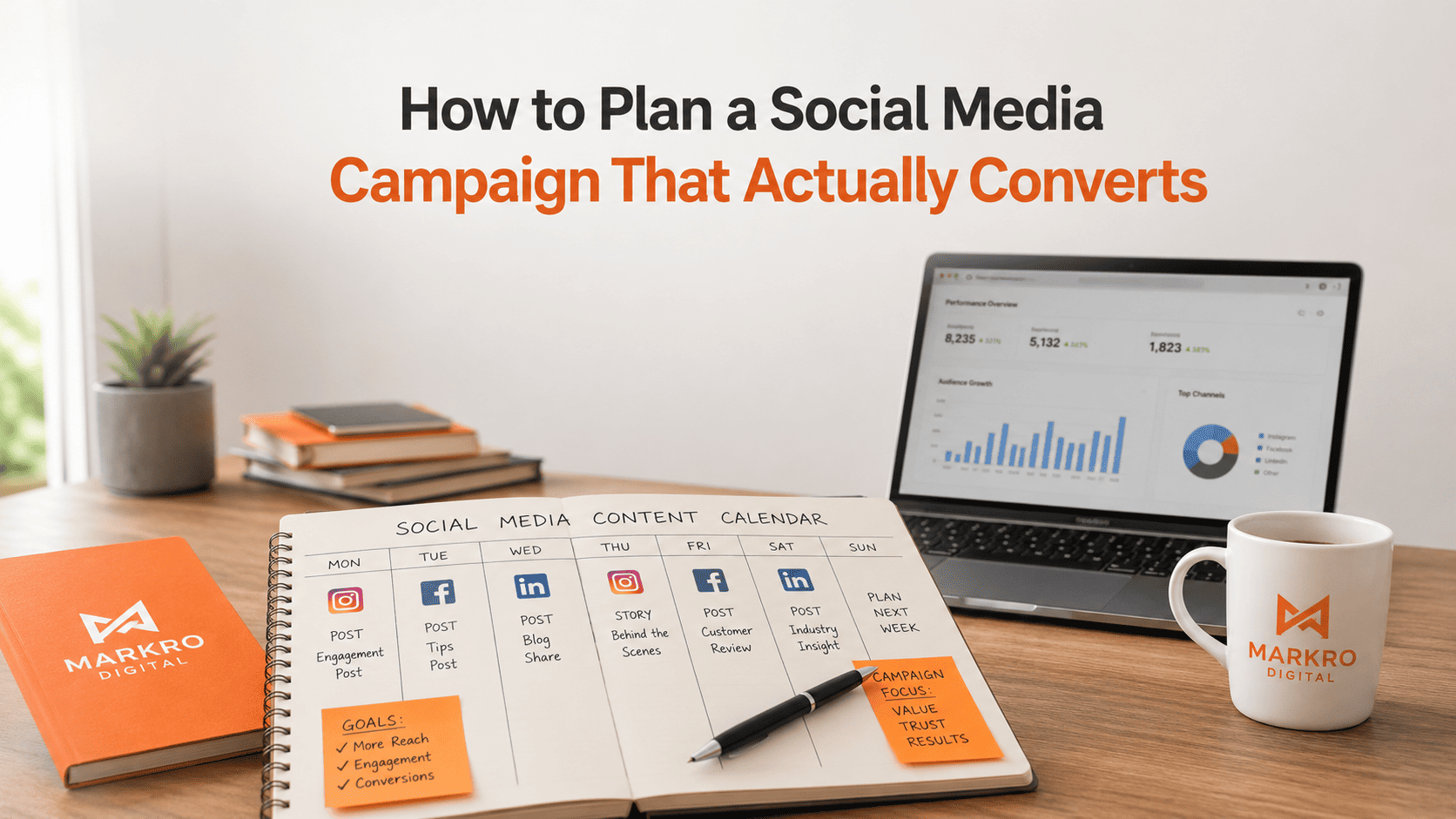
Planning a Social Media Campaign People Actually Act On
A social media campaign that converts starts with a plan, not a posting streak. Most businesses do the opposite. They post daily, stay busy, and wonder why the likes never turn into leads.
The reason is rarely a content problem. It’s a plan problem. When posting is reactive instead of planned, the same issues repeat every month: scattered topics, a brand voice that shifts by the day, and channels that feel disconnected from the website. Effort goes in. Results don’t come out. That gap is where most social media budgets quietly disappear.
This post walks through how to plan a social media campaign that earns action, from setting one clear goal to tracking the metrics that actually tie back to business results.
Quick Summary
A social media campaign that converts runs on a plan, not guesswork. Set one clear goal first, research your audience before writing a post, match content to each platform instead of copying it everywhere, and track metrics that connect to conversions. Random posting stays busy and flat. A planned campaign compounds.
What Separates a Social Media Campaign From Random Posting
A social media campaign is a set of coordinated posts working toward one goal over a defined period. Random posting is just activity with no destination. The difference shows up in the results.
Reactive posting creates a familiar set of problems:
- Posting on the fly with no calendar behind it
- Content that gets likes but never turns into traffic or leads
- A brand voice that shifts depending on who posts that day
- Social channels that feel disconnected from the website
None of that means social media doesn’t work. It means the structure underneath it is missing.
The channel itself pays off when it’s planned. HubSpot’s 2026 marketing statistics show social media and short-form video among the highest-return formats marketers use, which is exactly why a scattered approach wastes so much potential. A planned campaign turns that potential into something measurable, and it’s the foundation of our social media and content marketing services.
Define One Clear Goal Before You Plan a Social Media Campaign
Every social media campaign needs one job. Trying to build awareness, drive traffic, and generate leads with the same set of posts weakens all three.
Pick a single primary goal first:
- Awareness: reach new people who don’t know the brand yet
- Engagement: deepen the relationship with the audience you have
- Traffic: move people from the feed to your website
- Leads or sales: capture information or drive a purchase
The goal decides everything downstream. An awareness campaign uses different content, formats, and metrics than a lead campaign. Mixing them means none of the posts pull hard in any direction.
Get specific, too. “More followers” is a wish. “300 new email signups from a four-week campaign” is a goal, because it tells you what to make and how you’ll know if it worked.
Research Your Audience Before You Write a Single Post
The fastest way to waste a social media campaign is to build it on assumptions. Audience research replaces guesses with evidence, so every post reflects what people actually respond to.
The core challenge is that what people say and what they do often differ. Semrush’s guide to audience research makes this point directly: relying on one source of data skews your insight, so you cross-check what people say against what they actually do.
Useful research covers a few dimensions:
- Demographics and behaviors: who they are and what they actually do online
- Psychographics: what they value, care about, and believe
- Pain points: the real problems that would make them seek you out
- Platform habits: where they spend time and how they behave there
You gather this through analytics, surveys, reviews, and social listening. The goal is a clear picture of who you’re reaching before you decide what to say to them. Skip this step and even well-made content lands with the wrong people.
Match Content to the Platform, Not the Other Way Around
Copying one post across every platform is among the most common mistakes in any social media campaign. The same idea can work everywhere, but audiences consume it differently depending on where they are.
Each platform rewards a different approach:
| Platform | Best for | What works |
| Visual brands, direct to consumer | Polished visuals, reels, carousels | |
| Community, broad reach | Mixed formats, groups, longer captions | |
| B2B, professional offers | Insight-driven posts, longer captions | |
| TikTok | Awareness, younger audiences | Native-style short video, casual tone |
Platform choice should follow where your audience spends time, not which app is trending. A campaign that spreads thin across every channel usually underperforms one focused on the two or three that fit.
This is why platform-specific content sits inside real social media management, where each asset is shaped for its channel instead of pasted everywhere. One idea, adapted per platform, beats the same asset copied six times.
Track a Social Media Campaign With Metrics That Show Conversions
A social media campaign that converts is one you can measure against a business outcome. Vanity metrics feel good and prove little. The metric you track should match the goal you set at the start.
Here’s how goals map to the numbers that matter:
| Campaign goal | Track this | Not just this |
| Awareness | Reach, new followers | Total impressions alone |
| Engagement | Saves, shares, comments | Likes alone |
| Traffic | Link clicks, site visits | Post reach |
| Leads or sales | Signups, form fills, DMs, purchases | Follower count |
The pattern holds across all of them. Likes and impressions describe activity. Saves, shares, clicks, and signups describe intent, and intent is what turns into revenue.
Social and search also support each other here. Useful content gives your channels something worth sharing and gives your website something worth ranking, which is why social activity feeds into the search engine optimization work rather than sitting apart from it. Where you send that traffic matters too, so the content management system behind your site should turn clicks into clean, trackable visits.
Common Mistakes That Sink a Social Media Campaign
Most failed campaigns trip over the same avoidable errors. Forbes Communications Council members catalogued the common social media mistakes they see most, and the pattern is consistent.
Watch for these:
- No purpose per post. Every post needs one job: start a conversation, drive traffic, or generate a lead. Posting without a reason wastes the slot.
- The same content everywhere. Copying one asset across platforms ignores how each audience actually consumes content.
- Burying the hook. On social, you get one line to earn the scroll stop. Lead with the point, not the setup.
- Talking about yourself. Content that leads with company news instead of audience interest gets skipped. Start with what the audience cares about.
- Treating the feed like a billboard. Social is a two-way channel. Broadcast copy that reads like an announcement misses the platform’s tone.
The thread connecting all of these is the same one from the start: a plan. Each mistake comes from posting reactively instead of working from a strategy. Keeping that plan consistent is easier with a digital marketing expert team than with one person posting between other tasks.
The Bottom Line
A social media campaign that converts isn’t about posting more. It’s about posting with a plan. Set one clear goal, research the audience behind it, shape content for each platform instead of copying it everywhere, and track the metrics that connect to real outcomes. Do that, and the effort starts to compound instead of leaking away.
The businesses that win on social aren’t the ones posting the most. They’re the ones whose posts all point in the same direction, toward a goal they defined before the first post went out.
If your social media feels busy but flat, the fix is usually structure, not more content. Our social media and content marketing services build that structure from the first goal through to reporting. When you want a straight read on what your channels are missing, talk to our team and we’ll show you where to start.
FAQs
What is a social media campaign?
A social media campaign is a set of coordinated posts working toward one specific goal over a defined period. Unlike random posting, it has a clear objective, a target audience, planned content, and metrics to measure results. The goal can be awareness, engagement, traffic, or leads.
How do you plan a social media campaign?
Start with one clear goal. Research your audience to understand what they respond to. Plan content shaped for each platform, build a posting calendar, then publish and track performance against the goal. The plan comes before the first post, every time.
How long should a social media campaign run?
It depends on the goal. Awareness campaigns often run a few weeks to build reach. Lead or sales campaigns can run longer to gather enough data to optimize. The key is setting a defined start and end so you can measure results against a fixed window.
What makes a social media campaign successful?
One clear goal, content built around the audience rather than the brand, platform-specific formatting, and consistent measurement. Successful campaigns track intent signals like saves, shares, and clicks, not just likes. Structure and consistency matter more than volume.
How do you measure social media campaign results?
Match the metric to the goal. Track reach and new followers for awareness, saves and shares for engagement, link clicks for traffic, and signups or sales for conversions. Focus on the numbers that connect to a business outcome, not vanity metrics.