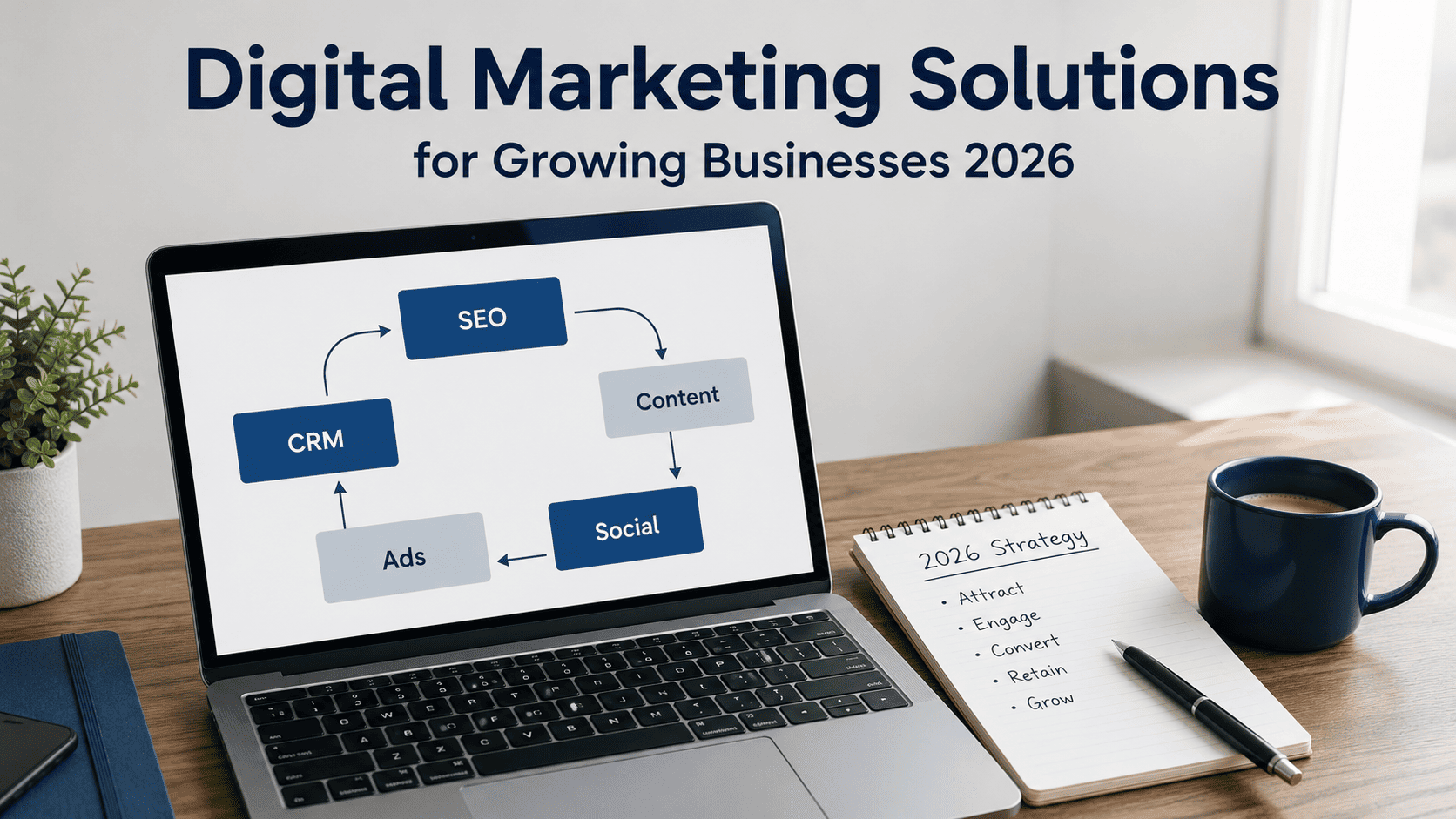
Digital Marketing Solutions That Actually Connect in 2026
The businesses pulling ahead in 2026 aren’t the ones buying more digital marketing solutions. They’re the ones connecting the pieces they already have.
Most companies own the parts already. A website, a social account, maybe an ad budget and a blog nobody updates. Each piece works on its own, but nothing compounds, because none of them share a strategy. That’s a coordination problem wearing a marketing costume, and adding another channel won’t fix it.
This breakdown covers the digital marketing solutions worth attention in 2026, what each one does, and how to tell which ones your business actually needs first.
Quick Summary
The digital marketing solutions that matter in 2026 are SEO and content, social media, digital advertising, website and CMS work, and CRM automation. Search and content still drive the highest returns for most businesses. AI is changing how people search rather than replacing search itself. The winning setup connects these channels to one strategy instead of running them as separate jobs.
Digital Marketing Solutions Start With Strategy, Not Channels
The fastest way to waste a budget is picking channels before picking a direction. Effective marketing solutions get built around how your customers actually move, from a search result to a page to a decision.
Why fragmentation costs more than any single channel
Ask five business owners what digital marketing means and you’ll get five answers. One thinks of a neglected Instagram page. Another thinks of an ad account nobody has touched in two years. A third thinks of a site that stopped ranking months ago.
None of that is a marketing failure. It’s a fragmentation failure, and it shows up in predictable ways:
- Content exists with no strategy behind who it targets.
- A solid website has SEO that was never structured to support it.
- Ads point to a landing page that contradicts what the ad promised.
- Leads arrive and nothing catches them.
Our digital marketing services are built to close that gap. The work starts with research into your market and audience, then moves through planning, building, optimizing, and scaling, in that order.
The strategy-first sequence
Every engagement worth paying for follows roughly this path:
- Research. Audit what exists, what works, and what’s missing.
- Plan. Set goals from real data, prioritize by impact.
- Build. Execute what the plan calls for.
- Optimize. Adjust against early results.
- Scale. Put more weight behind what returns.
The Digital Marketing Services Worth Your Budget in 2026
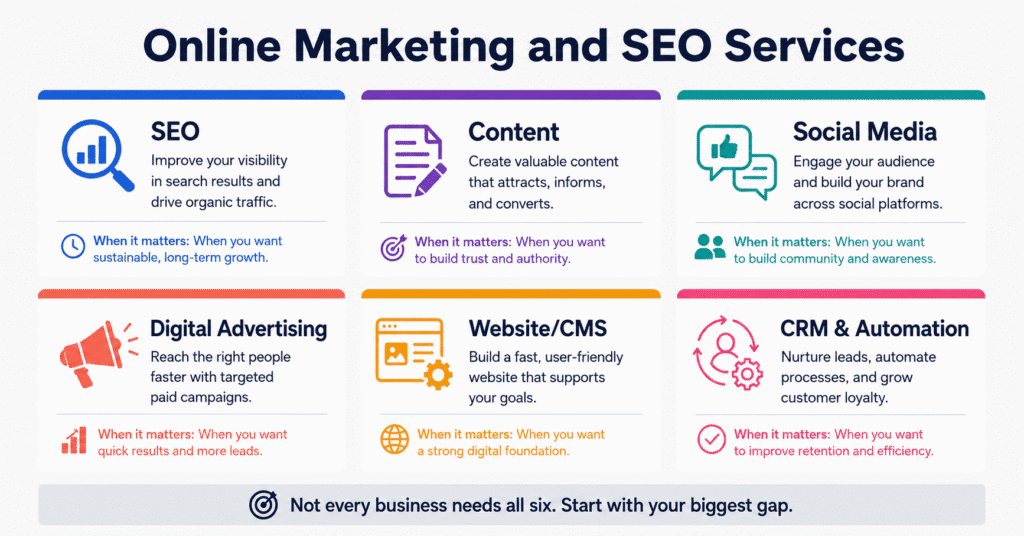
Six categories cover most of what businesses need. The right digital marketing solutions for you are a subset of this list, not all of it.
| Service | What It Handles | When It Matters Most |
| SEO | Keyword research, on-page work, technical fixes | Your site doesn’t surface for terms people search |
| Content | Blog posts, landing pages, service pages built on intent | You need pages that rank and convert |
| Social Media | Planning, posting, engagement, platform fit | Your audience is active somewhere you’re absent |
| Digital Advertising | Paid search, social ads, campaign management | You need speed, or want to amplify what works |
| Website / CMS | Structure, hosting, content management | The site itself is the bottleneck |
| CRM & Automation | Lead tracking, follow-up, sales handoff | Leads arrive and nothing happens next |
HubSpot’s 2026 marketing statistics put websites, blogs, and SEO at the top of the list for return on investment, with paid social following close behind at 26%. That ranking has held steady for years, which is worth remembering when a new platform gets loud.
Not every business runs all six. A local service company often needs search engine optimization and a cleaner site long before it needs an ad budget. A newer brand tends to need content and social media management first.
Pro tip: A question that comes up constantly is “which service should I buy first?” Start where the biggest gap sits. Invisible in search means SEO. Traffic without conversions means your site or follow-up. No traffic and no audience means content and social. Buying a full package before answering that question is how budgets disappear.
Online Marketing and SEO Services Anchor Everything Else
Among all digital marketing solutions, online marketing and seo services do the heaviest lifting because they compound. Ads stop the day you stop paying. Search visibility keeps working.
What changed about search in 2026
AI has shifted how people search, not whether they search. HubSpot’s 2026 data shows over 92% of marketers either use or plan to use SEO for both traditional and AI-driven search engines, while nearly 30% report search traffic dropping as users turn to AI tools.
That’s a change in method, not a death notice. The work adapts:
- Answer questions directly so AI systems can cite your pages.
- Build topical depth rather than one thin post per keyword.
- Keep the technical foundation clean so crawlers reach everything.
- Write for people first, which is what both readers and ranking systems reward.
Our SEO marketing services cover keyword research, on-page optimization, and technical work as one process. For the full picture of what sits inside a package, our breakdown of online marketing and seo services walks through each component.
Content is half the equation
Search and content aren’t separate purchases. Rankings need something to rank. HubSpot’s 2026 figures show smaller businesses are 23% more likely than average to see returns from blog content, which makes it one of the more reliable starting points for a limited budget.
The pairing matters more than either piece alone, something we covered in why an SEO content marketing agency has to run both together.
What a Digital Marketing Expert Brings That Tools Don’t
Software has gotten good. It still doesn’t decide anything. A digital marketing expert exists to make the calls that tools present as options, which is why the best digital marketing solutions pair technology with judgment.
Where human judgment still decides
Gartner’s marketing predictions for 2026 point to AI agents taking over routine execution, with marketers shifting toward supervising those systems rather than running individual campaigns. The work moves up a level. Someone still has to decide what’s worth doing.
That judgment shows up in specific places:
- Choosing which channel to fund when the budget only covers two.
- Reading why a campaign underperformed instead of just seeing that it did.
- Knowing when a trend doesn’t apply to your market.
- Connecting SEO, content, ads, and automation so they reinforce each other.
IE Business School’s analysis of digital marketing trends makes a related point about staying grounded: test small before committing big, and question any tactic, internal or agency-driven, against return rather than hype.
The skills gap is real. Our piece on what separates a digital marketing expert from a generalist covers what to look for.
Digital Advertising Companies vs. Connected Digital Marketing Solutions
Paid ads work. The problem starts when they’re the only thing running. Digital advertising companies that handle ads and nothing else leave gaps that cost more than the ad spend.
| Factor | Ads-Only Provider | Connected Provider |
| Speed | Fast, immediate traffic | Fast on paid, slower on earned |
| Cost over time | Stops the day spend stops | Search and content keep returning |
| Landing experience | Often outside their scope | Built to match the ad’s promise |
| Lead handling | Handed off, rarely tracked | Routed into CRM and follow-up |
| Compounding value | Minimal | Builds with every month |
The handoff problem
Marketing and sales lose track of each other the moment a lead arrives. That gap is where ad budgets quietly leak. HubSpot’s 2026 research still lists lead generation among the top challenges marketers name, and lead quality as the metric they care about most.
Closing it takes CRM systems and business automation that track where a lead came from and what should happen next. Ads without that infrastructure buy clicks, not customers.
Pro tip: People ask “should I run ads or SEO first?” If you need revenue this quarter, ads. If you’re building something that lasts, search and content. Most businesses eventually run both, with ads funding the wait while SEO matures. Just don’t let ads become permanent life support for a site that can’t earn traffic on its own.
Choosing Digital Marketing Solutions for Your Stage
The right digital marketing solutions depend on where your business sits right now, not on what a provider finds easiest to sell.
Match the work to the gap
- No search visibility? SEO and content first. The content management system behind your site matters here, because the wrong setup makes every fix harder.
- Traffic but no conversions? Look at site structure, page clarity, and whether follow-up exists at all.
- Steady leads but no capacity? That’s when a broader package earns its cost, with several channels under one plan.
- Everything disconnected? Start with strategy. Adding channels to a fragmented setup makes it worse.
Markro Digital organizes this into tiers for that reason. The Starter Plan handles foundations. The Growth Plan adds channels as workload increases. You shouldn’t pay for services you’re not ready to use.
What honest providers tell you
No agency can promise a specific ranking, a set number of leads, or a revenue figure. Anyone offering those guarantees is either misinformed or counting on you not knowing better. What you should get instead is a strategy built on your actual market, explained in language that doesn’t need a translator.
Not all digital marketing services are equal, and the difference usually comes down to whether the pieces connect or just coexist.
The Bottom Line
The digital marketing solutions that matter in 2026 haven’t changed as much as the noise suggests. Search and content still deliver the strongest returns for most businesses, social builds awareness, ads buy speed, and CRM catches what the others bring in. AI has changed how people find information without changing the fundamentals of being findable and being useful.
What separates results from spend is coordination. A business running five disconnected channels will lose to one running three that share a plan. That’s the whole difference, and it’s the part most providers skip because selling a full package is easier than diagnosing a real problem.
Our digital marketing services start with figuring out which gap is costing you most. When you want a straight answer about where your site stands, talk to our team and we’ll tell you what’s worth doing first and what can wait.
FAQs
What are the 4 types of digital marketing?
Most breakdowns center on search marketing, content marketing, social media marketing, and paid advertising. Email and automation often count as a fifth. The categories matter less than whether they run on one strategy or four separate ones.
What is a digital marketing strategy?
A plan that connects your business goals to specific channels and actions. It defines who you’re reaching, where they spend time, what you’ll publish or run, and how you’ll measure results. Without one, channel spending is guesswork.
What is SEO in digital marketing?
SEO is the work of making your site findable in search results. It covers keyword research, page structure, technical health, and content that answers what people search. It earns traffic over time rather than paying per click.
Why is digital marketing important?
It puts your business in front of people already looking for what you sell. That intent converts better than interruption. Search, content, and social also build assets that keep returning value after the work is done.
How do I choose a digital marketing agency?
Look for strategy before tactics, plain-language explanations, reporting tied to revenue rather than vanity metrics, and no guarantees on rankings. Ask what they’d do in your first 90 days. A clear, specific answer tells you more than any pitch deck.