Inside Social Media Marketing: Platforms, Strategy, and What Actually Drives Results
TL;DR: Social media marketing is leveraging social media platforms (Facebook, Instagram, LinkedIn, TikTok, etc.) to promote your brand, connect with customers and drive traffic or sales. It’s a mix of organic content, paid advertising, community engagement and analytics in one cohesive strategy. If a company just looks at it as a content calendar, they’re missing the platform selection, engagement and measurement that actually make the results happen.” Markro Digital starts at $799/mo and includes social media marketing in all plans.
A boutique retailer posted on Instagram every day for a year. Good photos, consistent captions, decent hashtags. Followers grew slowly. Sales didn’t move at all.
The issue wasn’t effort. It was that organic posting was the entire strategy. There was no paid promotion behind the best-performing content, no tracking of which posts actually drove traffic to the website, and no clear picture of which platform the target customers were even using most.
Social media marketing without a system behind it produces activity, not results. This guide breaks down what social media marketing actually is, how the pieces fit together, and where most businesses leave results on the table.
What Is Social Media Marketing?
Social media marketing using social media platforms like Facebook, Instagram, LinkedIn or TikTok to promote your business and increase brand awareness or engage with users and get traffic & sales. According to Wikipedia’s overview of social media marketing, The discipline involves content creation, community management, paid advertising and performance analysis on multiple platforms concurrently.
It is not one activity. It’s a blend of content strategy, platform-specific execution, audience engagement and measurement that all work toward defined business goals, not just follower counts.
How Is Social Media Marketing Different Than Simply “Being on Social Media”
Having a business page is not the same as running social media marketing. A page with no posting schedule, no engagement strategy, and no paid promotion behind it is a placeholder, not a marketing channel. Social media marketing requires an actual plan connecting content to a business outcome.
Core Components of a Social Media Marketing Strategy
A working social media marketing strategy is built from several connected pieces, not a single tactic run in isolation.
ComponentWhat It CoversPlatform selectionChoosing where the target audience actually spends timeContent strategyWhat gets posted, how often, and whyOrganic engagementResponding to comments, messages, and community activityPaid social mediaAds that extend reach beyond organic followersAnalyticsMeasuring what’s actually working
HubSpot’s guide to social media marketing notes that businesses seeing the strongest results treat these components as connected parts of one strategy, not separate tasks assigned to different people with no shared plan.
Facebook Marketing, Instagram Marketing and More – Selecting the Appropriate Platform
The type of business and audience totally determines the platform choice. Facebook marketing and Instagram marketing do work for most consumer facing businesses. LinkedIn is good for B2B companies. TikTok is a great fit for brands looking to engage with younger demographics through short-form video.
Facebook Marketing
Facebook marketing keeps on delivering for local brands, service providers and community brands thanks to its granular targeting options and the broad age range of its users.
Instagram Marketing
Instagram marketing works best for visually driven brands: retail, food and beverage, beauty, and lifestyle businesses. Reels and Stories currently drive the highest organic reach on the platform.
Matching Platform to Business Type
Sprout Social’s guide to social media marketing points out that spreading effort thin across every platform usually underperforms compared to going deep on the one or two platforms where the target audience is actually active.
Organic Social Media Growth vs Paid Social Media
These two approaches work differently and serve different purposes within a social media marketing strategy.
Social Media Growth Organicly
Organic growth is the process of growing your audience on social media over time. using Without Paid content such as posts, stories and reels. It is a slow process that build brand awareness and trust over the long term. but it’s reliant on consistently high quality content.
Social Media Paid
Paid social media is when you use ads to reach your target audience more quickly and accurately than you can with organic reach alone. See Markro Digital’s breakdown of Facebook advertising management for how paid campaigns are structured and optimized.
Most successful social media marketing strategies combine both. Organic content builds community and trust, and paid social media speeds up reach and drives specific business actions.
Content Marketing for Social Media: What Actually Performs
Social media content marketing is best when it has a purpose and isn’t just to fill a posting calendar. WordStream’s guide to social media marketing highlights that content tied to a specific audience need or question consistently outperforms generic promotional posts.
Types of Content That Create Social Media Engagement
- Educational posts that answer a common customer question
- Behind-the-scenes content that builds trust and familiarity
- User-generated content and testimonials
- Short-form video, which currently drives the highest reach across most platforms
Social Media for Small Business A Useful Starting Point
Social media for small business doesn’t require being active on every platform at once. It requires being consistent and strategic on the one or two platforms where the target customer actually spends time.
A Simple Starting Framework
- Identify where the target audience is most active.
- Instead of doing it infrequently, do it regularly, 3 to 5 times a week.
- Don’t just broadcast, interact with comments and messages.
- Extend the reach of top performing organic content with paid social media.
- Do a monthly review of the standard analytics in order to see what is actually working.
Social Media Examiner’s guide to social media marketing continually reminds us that it’s engagement — not just the sheer number of posts — that tells platform algorithms your content should be shown to more people.
Social Media Engagement: Why It Matters More Than Follower Count
When people comment, share, save, or reply to a post, it signals to the audience and the social media platform’s algorithm that the content is worth showing to more people. A page with 10,000 followers and no action is worse than a page with 2,000 followers that engages with content.
Additionally, engagement fosters the trust that eventually turns a follower into a customer—something that follower count by itself cannot accomplish.
Social Media Analytics: Measuring What Actually Works
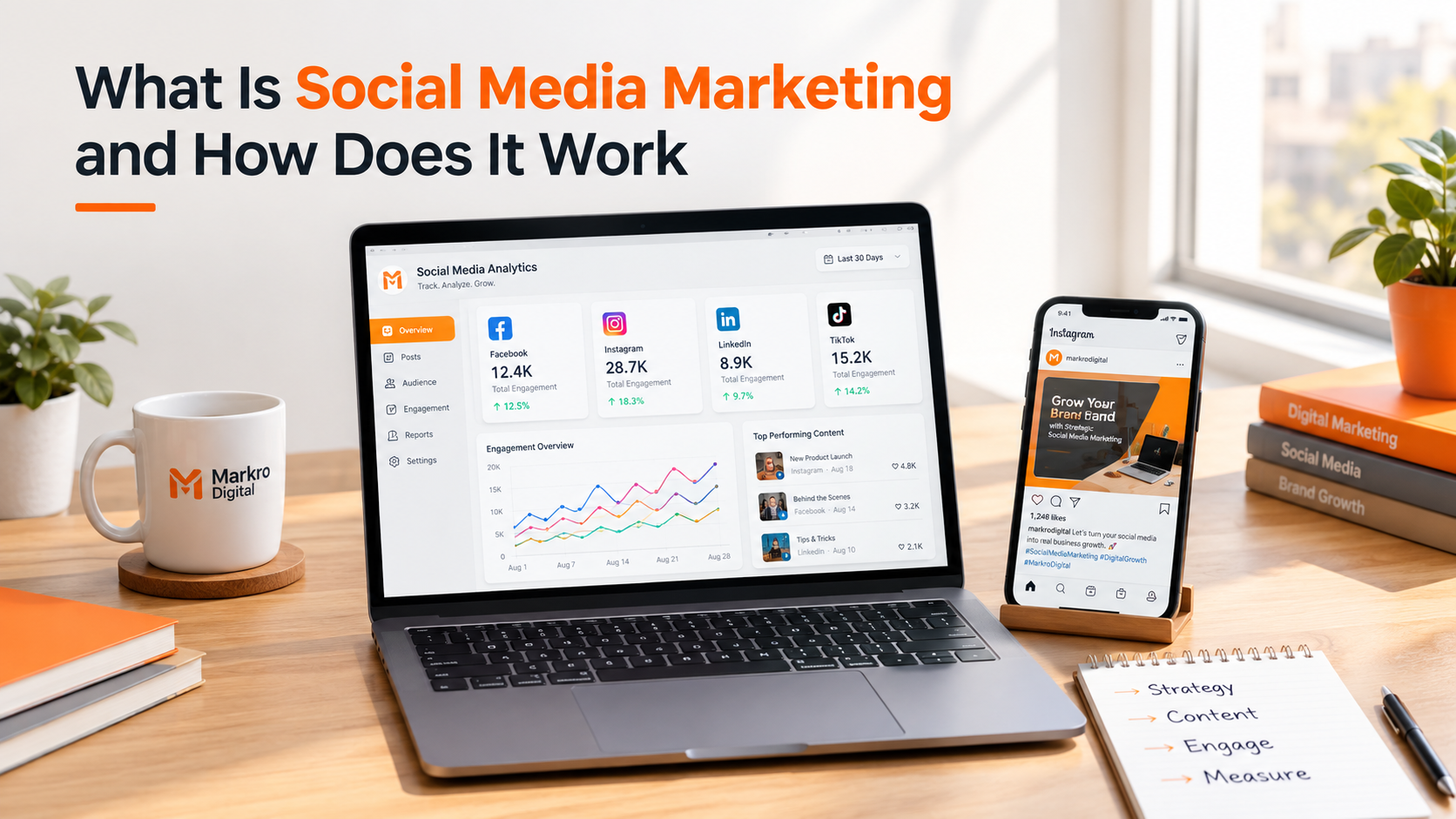
Social media analytics is about measuring how well your content and campaigns really are, not just how much they are seen.
Metrics Worth Tracking
- Reach and impressions: How many people saw our content
- Engagement rate: How many people interacted with us
- Click-through rate: How many people take action
- Follower growth: Whether the audience is expanding over time on Content
- Conversions: Whether social media activity is producing leads or sale’s
Most platforms have built-in analytics, and tools like Meta Business Suite can give you more insight across your accounts. Social media marketing is a guessing game until you have analytics in place to make it a measurable channel.
Social Media Brand Awareness: The Long Game
Social media brand awareness is built over time with consistent presence, a recognizable visual identity and repeated exposure to a target audience. It’s harder to measure directly than clicks or conversions, but it’s what makes paid campaigns more efficient over time, since audiences already familiar with a brand convert at a higher rate.
How Markro Digital Approaches Social Media Marketing
At Markro Digital, social media marketing runs as one connected system: organic content, social media management, and paid promotion working together rather than operating separately. See Markro Digital’s social media and content marketing services and how to plan a social media campaign that actually converts for more on how campaigns are structured.
Key Takeaways: Social Media Marketing
Social media marketing combines platform selection, content strategy, organic engagement, paid advertising, and analytics into one connected system. Businesses that treat it as posting alone miss the paid, engagement, and measurement pieces that actually drive results.
The strongest social media marketing strategies pick the right platforms for their audience, balance organic and paid social media, and measure performance consistently rather than relying on follower count as a proxy for success.
Markro Digital manages social media marketing as part of full social media marketing services. Get a free call to talk through a strategy, or see the portfolio for documented results.
Frequently Asked Questions: Social Media Marketing
1. What is social media marketing?
Social media marketing is the promotion of a business using social media platforms like Facebook, Instagram, LinkedIn, Twitter, TikTok to build brand awareness, engage with audiences and drive traffic & sales.
2. Which is the best social media platform for marketing?
It is contingent upon the type of business. “Most businesses can benefit from Facebook and Instagram. LinkedIn is better for B2B. TikTok is great for brands that want to reach younger audiences.
3. Paid vs organic social media marketing: what’s the difference?
Organic social media is the use of free content (posts, stories etc) to build your audience organically . “Paid social media is about using ads to reach a specific audience faster and with more precision.”
How frequently should a business post on social media?
Frequency is less important than consistency. Most businesses do great with 3-5 posts per week. The secret is churning out quality and keeping your audience glued all the time.
5. How social media marketing improves your SEO Rank?
Social media signals are not a direct Google ranking factor. But having a strong social media presence can drive more traffic to your website, increase brand searches and generate more backlinks, all of which can help with SEO.
6. How to measure social media marketing performance
Reach, Engagement Rate, Click-Through Rate, Growth of Followers, Conversions etc. Most platforms will have analytics and tools such as Meta Business Suite or Sprout Social will give you a more in-depth look.
How much does social media marketing cost?
Costs vary. Organic management can be done in-house at low cost. Hiring an agency typically ranges from $500 to $5,000+ per month depending on scope, platforms, and ad spend included.